
Business Professional Attire: A Modern Style Guide for Men and Women

According to a study by IWG, 79% of hybrid employees have significantly changed their business professional attire. During the pandemic, we spent months in sweatpants. We transitioned to “Zoom shirts,” where we were business on top and pajama party on the bottom. Now, we find ourselves in a weird limbo.
On the flip side, I see people swinging too far the other way. They drift into casual territory that quietly undermines their expertise. This matters because perception is reality. Data shows that 69% of people believe your attire directly reflects your title and role.
Below, we discuss the 10 distinct styles that define the modern professional wardrobe. This isn’t just a list of clothes. It is a breakdown of how to build a rotation that actually works for the life you live right now.

What is Business Professional Attire?
Business Professional attire is the most conservative and authoritative corporate dress code. It is a step up from “Business Casual” but slightly less formal than “Black Tie.”
The goal of this dress code is to project competence, polish, and uniformity. When you walk into a room, your clothes should signal that you are there to lead, negotiate, or represent the company at the highest level.
The Core Elements
1. For Men:
- The Suit: A matching jacket and trousers in a dark, neutral color (Navy, Charcoal, or Black).
- The Shirt: A crisp, collared button-down dress shirt (usually white or light blue).
- The Tie: Essential. Stick to silk or high-quality blends in solid colors or subtle patterns.
- The Shoes: Leather Oxfords, Derbies, or high-end Loafers. Never sneakers.
2. For Women:
- The Suit: A matching pantsuit or skirt suit in neutral tones.
- The Dress: A structured sheath dress (knee-length) worn with a blazer.
- The Top: A high-quality blouse, shell, or fine-gauge knit.
- The Shoes: Closed-toe heels (block or stiletto), pointed-toe flats, or dress loafers.
How It Has Changed (The “Modern Twist”)
While the look remains conservative, the feel has changed.
- Fit Over Flash: It is no longer about expensive labels; it is about the “geometry” of the fit (e.g., proper shoulder alignment, no fabric puddling).
- Technical Fabrics: The modern version incorporates “Commuter Wear”—suits made with 4-way stretch and moisture-wicking technology that allow for movement without losing the sharp silhouette.
- Separates (Spezzato): In less rigid industries, wearing unmatched but high-contrast separates (e.g., Navy blazer + Grey trousers) is now acceptable.
What It Is NOT:
- No denim (jeans).
- No sneakers (even leather ones).
- No polo shirts.
- No leggings or hoodies.
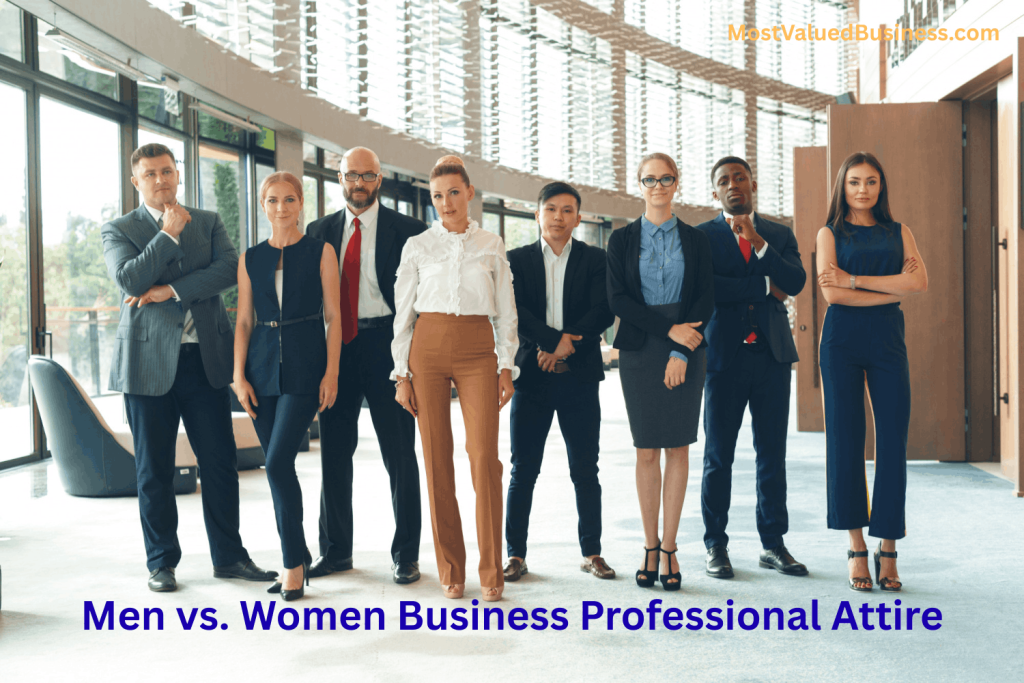
At a Glance: Men vs. Women Business Professional Attire
Different ways men and women can style their Business Professional Attire
| Component | For Men | For Women |
| The Power Suit | Tailored shoulder, no-break trousers, 2-button jacket. | Sheath dress with blazer or tailored pantsuit. |
| The Top | Crisp spread-collar shirt or merino turtleneck. | Silk blouse, shell top, or high-GSM knit. |
| Footwear | Oxford lace-ups, Leather Loafers, Chelsea Boots. | Block Heels, Pointed Flats, Loafers. |
| The Bag | Leather Briefcase, Portfolio, Structured Backpack. | Structured Tote (stands up on its own). |
| Accessories | Analog watch, leather belt (match shoes). | Statement necklace, silk scarf, minimalist watch. |
| Grooming | Clean shave or lined beard; crisp haircut. | Polished “no-makeup” makeup; neat hair. |
The 10 Pillars of Business Professional Attire
Here are a few pillars of Business Professional Attire:
| Style Archetype | Best For | Key Element |
| 1. The Modern Suit | Interviews, Board Meetings | Shoulder fit & tailored hem |
| 2. Tonal Dressing | High-Stress Mornings | Texture variance (wool vs. silk) |
| 3. The Sheath Dress | Efficiency & Travel | Heavyweight fabric (High GSM) |
| 4. The “Spezzato” | Client Lunches / Creative | High-contrast separates |
| 5. The Commuter Hybrid | Hybrid Work / Travel | Technical stretch fabrics |
| 6. The Textured Pro | Winter / Authority | Heritage weaves (Tweed, Flannel) |
| 7. The Minimalist | Focus / Decision Fatigue | Strict template (The Uniform) |
| 8. The Creative Pop | Tech / Marketing | Turtlenecks & bold accessories |
| 9. The Anchor Bag | Daily Commute | Structured leather |
| 10. The Walking Shoe | All-Day Comfort | Block heels & broken-in leather |
1. The Tailored Suit: The Modern Standard
Let’s address the elephant in the room first. The suit.
There is a massive misconception that looking like a boss requires a five-figure budget. People think you need a trip to a dusty bespoke shop on Savile Row. That is absolute nonsense.
You can buy a suit for $5,000 and look sloppy. Alternatively, you can buy one for $400 and look like you own the building. The difference isn’t the label stitched inside the pocket. It is the geometry.
When you wear a suit straight off the rack, those little discrepancies show up. You get wrinkles, bunches, and awkward gaps behind the neck. To a client or a hiring manager, ill-fitting clothes read as a lack of attention to detail.
The Fix:
Always buy the suit that fits your shoulders perfectly, as the Italians do. The shoulder pads should end exactly where your natural shoulder ends.
If you get that right, a local tailor can fix the rest. It usually costs the price of a nice lunch.
- Waist Suppression: Ask the tailor to nip the jacket in at the waist. This creates a “V” shape for men or an hourglass silhouette for women. Psychologically, this shape is viewed as more authoritative and athletic.
- The Break: Ask for a “slight break” or “no break.” This means the trousers just kiss the top of the shoe. The days of excess fabric puddling around your ankles are over. That look makes you appear shorter and sloppier.
- Sleeve Pitch: Show a sliver of shirt cuff. About half an inch is perfect. It isn’t just an old-school rule. It provides a visual break that makes your arms look longer. It makes the jacket look custom-made.
2. Tonal Dressing: The Monochrome Look
There is a reason you see tech billionaires and fashion editors wearing all black, all navy, or all grey. It cuts through the noise.
When you wear a single color from head to toe, you remove the visual clutter. You create a long, unbroken vertical line. This makes you look taller, leaner, and infinitely more put-together.
The Strategy:
The trick to avoiding the “uniform” look is Texture Variance. You must mix materials that interact with light differently.
- The Wrong Way: Grey cotton shirt + grey cotton chinos. This looks flat and dull.
- The Right Way: Charcoal wool flannel trousers (matte texture) + Slate grey silk blouse (sheen) + Herringbone blazer (rough texture).
Suddenly, the outfit has depth. It catches the light in different ways. It looks intentional.
This is my go-to strategy for days when I have zero mental energy to spare. I don’t have to worry about matching patterns or color theory. I just grabbed three grey things. I make sure the textures are different. I walk out the door looking like I spent an hour getting ready.
3. The Sheath Dress: The One-Piece Strategy
For women, the sheath dress is the ultimate efficiency hack. I always tell my clients that if they have a high-stress week coming up, they need to lean on “one-and-done” pieces.
Separates are high maintenance. You spend half your day worrying about your shirt untucking. You worry about your waistband twisting. You worry about the zipper on your skirt sitting weirdly.
A sheath dress eliminates all of that physics. You zip it up, and you are locked in. It is a set-it-and-forget-it garment.
The Fabric Secret:
Not all dresses are created equal for the boardroom. The specific detail you need to look for is the fabric weight. In the industry, we talk about GSM (grams per square meter). You want something heavy. You want a dress that feels substantial in your hands.
- Look For: “Ponte di Roma” knits or double-faced wools.
- Avoid: Flimsy, thin jersey fabrics. They betray you. They cling to every line. They show undergarments. They look cheap under harsh office lighting.
A heavy, structured fabric acts like armor. It smooths everything out. It holds its shape whether you are standing at a podium or sitting in a three-hour strategy session.
Styling Tip: Watch the neckline. For the modern workplace, a boat neck or a modest V-neck is best. It frames the face beautifully for video calls without being too revealing.
4. The “Spezzato” Technique: Mixing Separates
Sometimes, a full suit feels like too much. Maybe it’s a Tuesday. Maybe you are meeting a client who you know wears jeans. Walking in with a matching suit might create a weird power dynamic. It can make you look stiff or out of touch.
This is where you master the art of “Spezzato.” It is the Italian technique of mixing a suit jacket with unmatched trousers to create a relaxed professional look. It simply means mixing the jacket from one suit with the pants of another. It bridges the gap between “Business Formal” and “Business Smart.”
If you wear a navy blazer with navy pants that you bought from a different store, the shades will never match perfectly. It looks like you got dressed in the dark. It seems like a mistake.
The Rule:
You need High Contrast. The pairing has to look deliberate.
- Grey and Navy: Pair a classic navy blazer with grey flannel trousers. It is the gold standard. It creates a trustworthy, academic vibe.
- Camel and Black: Try a camel-colored wool jacket over black trousers. It looks incredibly chic and modern.
- Texture and Smooth: Mix a rough tweed jacket with sleek, smooth cotton chinos.
This style says, “I respect the dress code, but I also have a personality.”
5. The Commuter Hybrid: Performance Professional
The fashion industry panicked for a minute. Then, they adapted. We are now seeing a massive surge in what I call “Commuter Wear.”
These are clothes that are cut to look like traditional business attire. They have sharp lapels, creased trousers, and button cuffs. But they are made from technical fabrics.
We are talking about:
- 4-way stretch.
- Moisture-wicking materials.
- Wrinkle resistance.
You can now buy “trousers” that look like Italian wool from five feet away but feel like yoga pants when you sit down. Some even come with hidden elastic drawstrings inside the waistband.
The key piece to own here is the Knit Blazer. It looks like a suit jacket, but it is unconstructed. It has no lining and no heavy shoulder pads. It feels like wearing a heavy cardigan.
6. The Textured Professional: Heritage Weaves
Cheap suits are often made from high-polyester blends that reflect light. Under fluorescent office lights, they make you look like you are wrapped in plastic. They also trap heat. This is a recipe for disaster during a stressful presentation.
The upgrade here is Texture. You want fabrics that absorb light. Think about a grey flannel suit versus a shiny grey sharkskin suit. The flannel looks soft, matte, and rich. It has visual weight.
Incorporating heritage weaves adds a layer of academic authority to your look. Look for:
- Herringbone: The classic V-shaped pattern.
- Houndstooth: A subtle, broken check pattern.
- Tweed: A rough, woolen fabric.
In the winter, try wearing a cable-knit sweater under a blazer instead of a dress shirt. It is a sophisticated move. It softens your image while keeping you looking sharp.
7. The Minimalist Uniform: A Business Uniform
There is a reason why Steve Jobs wore a turtleneck. There is a reason Barack Obama only wore blue or grey suits. It is called Decision Fatigue.
Psychologists have proven that we have a finite amount of willpower each day. Every decision you make chips away at that reserve.
- What to eat.
- What to email.
- What to wear.
If you spend 20 minutes every morning agonizing over your outfit, you are burning fuel that you need for your actual job.
Creating a business professional attire is a power move. This doesn’t mean you wear the same clothes every day. Please wash your clothes. It means you set a strict template.
The Template:
Maybe your uniform is White Button-Down + Black Slim Trousers + Loafers.
Great. Now go buy five high-quality white shirts. Buy three pairs of those trousers. Your morning routine just went from 20 minutes to 30 seconds.
You will always look consistent. You will always match. You will never stress about it. It’s efficient, clean, and gender-neutral.
8. The Creative Pop: Tech and Marketing Attire
If you work in marketing, PR, design, or tech, looking too stuffy can actually hurt you.
If you show up to a pitch meeting at a cool startup wearing a three-piece black suit, you look out of touch. You look like the IRS agents coming to audit them. You need to mirror the culture while still maintaining authority.
This style takes the chassis of “Business Professional” and gives it a new paint job. You keep the suit because the suit commands respect. But you swap out the stuffy components.
The Pivot:
Ditch the light blue dress shirt and the silk tie. Instead, wear a fine-gauge merino wool turtleneck. Choose a deep, interesting color.
- Forest Green.
- Burgundy.
- Rust Orange.
9. The Anchor Accessory: Professional Bags
Here is a hard truth. You can wear a perfectly tailored suit. But if you pull a battered, free-swag backpack out from under the table, you have ruined the illusion.
We carry our lives with us these days. We have laptops, chargers, water bottles, and gym clothes. But your bag is part of your outfit. It is the Anchor Piece.
If you invest in one thing this year, make it a high-quality leather bag.
- For Men: If you must use a backpack for your commute, buy a “grown-up” backpack. Look for leather or heavy, structured canvas. Avoid the nylon hiking bags with a million bungee cords. A leather portfolio for walking into the actual meeting room is also a great touch.
- For Women: You want a “Structured Tote.” This means if you set the bag on the floor, it stands up. It doesn’t puddle into a pile of leather. It looks organized, even if the inside is a mess of receipts and gum wrappers.
10. The Walking Shoe: Mobility and Comfort
I used to think that the louder my heels clicked in the hallway, the more powerful I was. I was wrong. The only thing I was doing was destroying my feet. I was distracting myself with pain.
You cannot focus on your quarterly review if you have a blister forming on your heel.
The era of the “sitting shoe” is dead. The modern workplace is about mobility. We are commuting. We are grabbing coffee. We are walking to lunch.
- For Women: The block heel is your best friend. It gives you the height and the posture boost of a heel. But it gives you the stability of a flat. Speaking of flats, a pointed-toe flat is incredibly chic and professional.
- For Men: If you are buying new leather shoes, break them in at home. Wear them with thick wool socks while you watch Netflix for a few nights. Soften that leather before you try to survive an 8-hour day in it.
- The Investment: Buy cedar shoe trees. They cost maybe $20. When you take your shoes off, put the trees in. They absorb the sweat that rots the leather. They keep the toes from curling up like elf shoes. Your shoes will last twice as long.
Seasonal Strategy: Summer vs Winter
| Feature | Summer (Warm Weather) | Winter (Cold Weather) |
| Fabrics | Linen-Wool blends, Tropical Wool, Cotton. | Wool Flannel, Tweed, Cashmere, Corduroy. |
| Colors | Light Grey, Tan, Soft Blue, Beige. | Charcoal, Navy, Forest Green, Burgundy. |
| Layering | Single breathable layer (no undershirt or moisture-wicking). | 3-Piece Rule: Vest, Cardigan, or Overcoat essential. |
| Footwear | Loafers (sockless look), Breathable Flats. | Leather Boots, Rubber-soled Oxfords. |
| Outerwear | Unlined Blazer or Trench Coat. | Wool Topcoat or Peacoat (must fit over suit). |
Common Mistakes to Avoid
Before I send you off to rebuild your wardrobe, let’s set some boundaries. There are a few things that will immediately disqualify you from the “Best Dressed” list.
- The Visible Undershirt: Gentlemen, listen up. If you are wearing a white dress shirt and I can see the bright white outline of your t-shirt underneath, it ruins the lines of your outfit. Switch to a grey or heather-grey undershirt. Physics dictates that grey blends with skin tones and disappears under white fabric.
- The Wrinkle Monster: I hate ironing. We all hate ironing. But walking into a meeting looking like a crumpled receipt is a career killer. Buy a handheld steamer. It takes 45 seconds in the morning while your coffee brews.
- The “Club” Shirt: If your shirt has a double collar, contrast stitching, or is made of shiny black satin, burn it. That belongs in a nightclub in 2011. It does not belong in a boardroom in modern times.
- The Sneaker Slip: While sneakers are acceptable in many creative offices, rules still apply. If the invite explicitly says “Business Professional,” do not wear them. Stick to leather. Save the high-tops for casual Fridays.
Frequently Asked Questions (FAQ): Business Professional Attire
Business professional attire is a polished, authoritative dress code. It includes tailored suits, tonal separates, and structured dresses. Unlike the past, it now incorporates comfortable technical fabrics and separates (Spezzato). It strictly excludes denim, hoodies, and open-toed shoes.
In most industries, yes. For creative, tech, or startup roles, high-contrast separates are perfectly acceptable. For example, a navy blazer and grey trousers work well. However, for conservative fields like Law, Finance, or Government, a full matching suit is still the safest and most respectful choice.
The Third Piece Rule suggests that every outfit needs three elements to look finished and authoritative:
1. A top (shirt/blouse)
2. A bottom (pants/skirt)
3. A structured layer (blazer, cardigan, or vest)
This third layer adds visual weight to the silhouette. It distinguishes “work wear” from “casual wear.”
Hybrid work has introduced “Business Comfort.” This style prioritizes technical fabrics like stretch wool or ponte knit. These offer the visual sharpness of a suit with the comfort of loungewear. It is designed to be comfortable for commuting and sitting on video calls while maintaining a professional appearance.
Final Thoughts
At the end of the day, clothing is just fabric. It doesn’t do the work for you. It doesn’t make the sale, and it doesn’t write the code.
But business professional attire is a role we play. It is a costume for the career version of ourselves.
Don’t let your clothes be a source of friction. Treat them as an investment in your own confidence. Find the pieces that make you feel capable. Get them tailored to fit the body you actually have. Then, stop thinking about them.
Go in there and crush it.
Read Also:
tags
Richard Watson
Richard Watson is a dynamic author on finance and business. He lives in New York City. Who has been winning hearts and minds with his 9+ years of experience, expertise, and blogging. With a Master's in Computer Applications, he transforms complex financial concepts into accessible insights that resonate with both seasoned professionals and novices. His notable work has established him as an expert, guiding businesses to thrive in the digital world. He is currently on Content Operations Associate | MoneyOutlined.com & MostValuedBusiness.com