Decoding Giniä: A Simple Guide to Its Origins and Mystery

To understand Giniä, we have to travel back in time.
The year is 1912. The world is on the brink of massive change. Industrialization is booming. Cities are growing. And in Italy, a statistician named Corrado Gini is thinking deeply about fairness.
Corrado Gini noticed something troubling. He saw that wealth wasn’t just sitting in one pile. It was moving. It was flowing. But it wasn’t flowing to everyone equally. Some people held vast fortunes, while others scraped by with nothing. He wanted a way to measure this. He wanted a number that could tell you, instantly, how “equal” or “unequal” a group of people was.
He developed a mathematical formula. The world came to know it as the “Gini Coefficient” or the “Gini Index.”
So, where does Giniä come from?
Think of Giniä as the modern evolution of Corrado’s original idea. Over the last century, the concept grew. It stopped being just a statistic in a textbook. It became a cultural force. It became a topic of political debate. The term “Giniä” captures this broader spirit. It represents not just the math, but the impact of inequality on our modern world. It is the legacy of Corrado Gini, reimagined for the digital age.
It is a bridge between the past and the future. It reminds us that the questions Corrado asked in 1912 are the same questions we are asking today.
What Is Giniä?
Let’s strip away the math. How does Giniä actually work?
Imagine a village with 100 people.
In a world of perfect equality, every single person in that village has the same amount of money. If the village has $100 total, everyone has $1. In Giniä terms, this is a score of 0. It is a flat line. Everyone is the same.
Now, imagine a world of perfect inequality. In this version of the village, one single person has all $100. The other 99 people have nothing. Zero. In Giniä terms, this is a score of 1.
Real life, of course, lives somewhere in the middle.
Giniä measures where we stand on that scale between 0 and 1.
- A low Giniä score (like 0.25) means the society is very equal. Most people earn a similar amount. You see this in countries like Norway or Sweden.
- A high Giniä score (like 0.60) means the society is very unequal. A small group of elites holds most of the wealth, while the rest struggle. You see this in many developing nations and, increasingly, in some wealthy ones too.
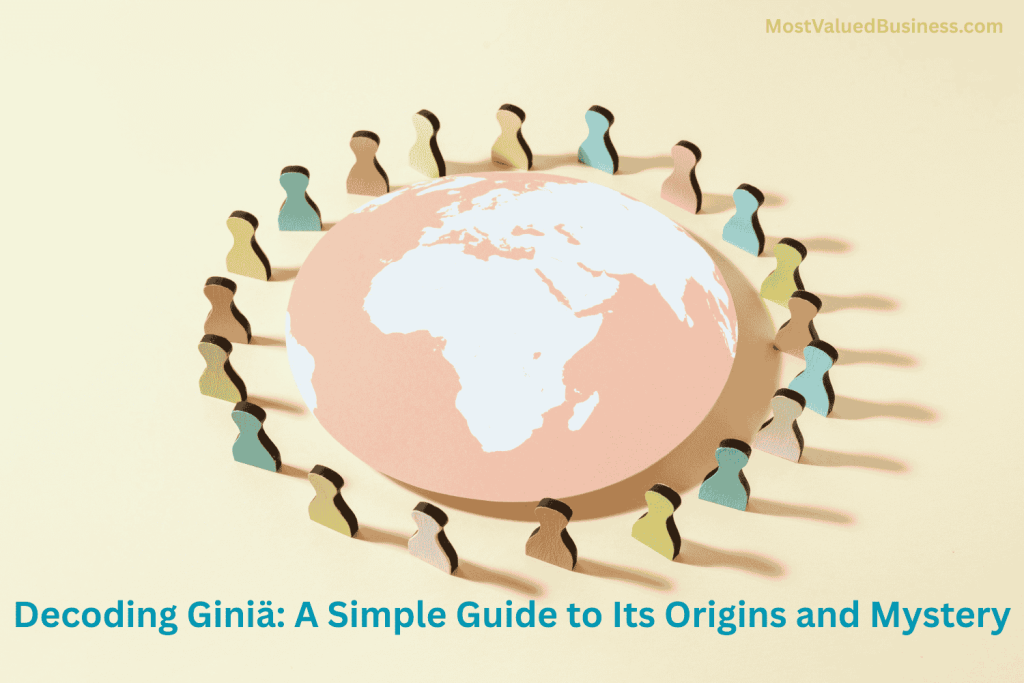
The Economic Heartbeat: How Giniä Shapes Our World
Giniä is not just a passive number. It is active. It shapes decisions in government halls and corporate boardrooms.
The Policymaker’s Compass
Governments use Giniä like a compass. When the score gets too high, alarm bells ring. A high Giniä score is dangerous. It predicts social unrest. It predicts crime. It predicts that people will stop trusting their leaders.
When policymakers see the Giniä score rising, they know they need to act. They might introduce progressive taxes, where the rich pay a higher percentage. They might increase funding for public schools or healthcare. These are tools to push the score back down toward zero. They are trying to “flatten” the curve of inequality.
The Business of Inequality
Corporations watch Giniä too. They know that in a highly unequal society, the “middle class” disappears. They either have to sell luxury goods to the ultra-rich or cheap essentials to the struggling masses. The Giniä score changes what products sit on the shelves. It changes who gets a loan and who doesn’t.
In a way, Giniä is the invisible hand guiding the market. It determines who has purchasing power. If wealth is concentrated at the top, the economy slows down because ordinary people don’t have money to spend. Giniä reveals this blockage in the system.
Giniä and Technology: A Double-Edged Sword
We live in the age of the internet, AI, and automation. How does technology affect Giniä? This is one of the most heated debates in modern economics.
The Great Equalizer?
On one hand, technology can lower the Giniä score. The internet gives everyone access to information. A kid in a remote village can learn coding online and start a global business. Mobile banking allows farmers in developing nations to access credit. In this view, technology spreads opportunity. It flattens the playing field.
The Great Divider?
On the other hand, technology can push the Giniä score through the roof. Think about automation. When a factory replaces 100 workers with one robot, the owner of the robot keeps all the profit. The 100 workers lost their income.
The wealth shifts from the many to the few. Think about the “gig economy.” Apps might create jobs, but they often create low-paying, unstable jobs without benefits. Meanwhile, the tech giants who own the platforms become trillionaires.
This digital divide is a major driver of modern Giniä. We are seeing a split between the “digital elite”—those who build and own the tech—and everyone else. As AI advances, this gap might widen. Giniä serves as a warning light on the dashboard of progress. It asks us: Progress for whom?
Cultural Contexts: How Different Worlds View Giniä
Giniä is a universal number, but it means different things in different cultures.
The American Dream vs. The Reality
In the United States, there is a strong cultural belief in the “self-made” individual. The culture accepts some level of inequality as the price of freedom and innovation. People tolerate a higher Giniä score if they believe they can climb the ladder.
However, as the Giniä score in the US has risen over the last few decades, that faith is shaking. People are realizing that high inequality makes social mobility harder, not easier. The “Dream” becomes a fantasy if the rungs of the ladder are too far apart.
The European Model
In many parts of Europe, particularly Scandinavia, the culture views Giniä differently. There is a strong social consensus that extreme inequality is bad for the soul of the nation. They willingly pay higher taxes to keep the Giniä score low. They value social stability and collective well-being over individual billionaires. For them, a low Giniä is a badge of honor.
The Emerging Markets
In places like Brazil, India, or South Africa, Giniä is a daily reality of survival. You can see the Giniä score with your own eyes. It is the skyscraper standing right next to the slum. In these cultures, reducing Giniä is not an abstract economic theory. It is a matter of life and death, of hunger and health.
The Human Cost of a High Giniä Index
We have talked about numbers. Let’s talk about feelings.
What does it feel like to live in a high-Giniä society?
Psychologists have studied this. They found that in societies with high inequality, stress levels go up for everyone, even the rich.
- Trust erodes. You stop trusting your neighbor because you feel you are in a fierce competition for survival.
- Health declines. Stress causes heart disease, anxiety, and depression.
- Crime rises. When people feel the system is rigged, they stop following the rules.
A high Giniä coefficient creates a culture of fear. The rich build higher walls to protect their wealth. The poor feel angry and left behind. The sense of “community” breaks down. We stop being citizens together and start being rivals.
This is why Giniä matters. It measures the health of our collective spirit. A lower Giniä score often correlates with happier, safer, and more trusting societies.
Criticisms: Is Giniä the Perfect Measure?
We must be honest. Giniä is not perfect.
Critics argue that it is too simple. You can have two countries with the same Giniä score but very different lives.
- One country might be equally poor (everyone is starving).
- The other might be equally rich (everyone is comfortable). Giniä doesn’t tell you how rich the country is. It only tells you how the pie is cut.
Also, Giniä often misses the hidden wealth. It is easy to measure a paycheck. It is hard to measure the value of stocks, hidden assets, or generational property. The super-rich often have wealth that Giniä doesn’t fully capture.
Finally, some people say we focus too much on equality. They argue we should focus on poverty. If the poor are getting richer, does it matter if the rich are getting richer faster? This is a valid debate. But Giniä reminds us that relative position matters. Humans are social creatures. We compare ourselves to others. If the gap becomes too wide, the society destabilizes, even if the poor are technically doing better than before.
Conclusion: Why You Should Care About Giniä
We started this journey with a broken car. A symbol of a system that looks good on the outside but fails when you test it.
Giniä is the mechanic’s report. It tells us the truth about the engine of our society.
You should care about Giniä because it affects your life every day. It affects the safety of your streets. It affects the price of your home. It affects the quality of your child’s education. It affects your mental peace.
Understanding Giniä is the first step toward changing it. When we can name the problem, we can fix it. We can demand policies that lower the score. We can support businesses that pay fair wages. We can treat each other with the dignity that bridges the gap.
The word “Giniä” might be new to you. It might seem like a typo or a strange buzzword. But do not ignore it. It is defining the 21st century. It is the scoreboard of our humanity.
As we move forward, let us keep our eyes on the Giniä. Let us strive for a world where the line on the graph bends toward justice. Let us build a vehicle that doesn’t just look sleek, but runs smoothly for everyone inside.
Deeper Dive: The Cultural Nuances of Giniä
To truly grasp the “mysterious” nature of Giniä, we have to look at how it bleeds into our art, our movies, and our daily conversations, even if we don’t use the word.
Giniä in Pop Culture
Have you seen the movie Parasite? Or the show Squid Game? These are stories about Giniä. They are visual representations of extreme inequality. They show us the physical and emotional walls that separate the “haves” from the “have-nots.”
In Parasite, the rain is a romantic backdrop for the rich family. For the poor family, that same rain is a flood that destroys their home. That is Giniä in action. It is the same event experienced differently because of where you stand on the curve.
When we talk about “The 1%” vs “The 99%,” we are using the language of Giniä. This concept has moved from textbooks to protest signs. It has become the defining conflict of our generation.
The Interpretation of “Fairness”
One of the most fascinating things about Giniä is that nobody agrees on what the “perfect” score is. Is a score of 0 (total equality) actually good? Most people would say no. If a doctor gets paid the same as someone who doesn’t work at all, that feels unfair, too. It might kill motivation.
So, Giniä forces us to ask: What is fair inequality? Is it fair that a CEO makes 300 times more than the average worker? Is it fair that a teacher makes less than a hedge fund manager? Giniä doesn’t answer these questions. It just holds up the mirror. It forces us to have the conversation.
The “Giniä” of Opportunity vs. Outcome
There is a subtle distinction we must make. Are we measuring the Giniä of Outcome (how much money you end up with)? Or the Giniä coefficient of Opportunity (how fair was the race)?
Most cultures value a low Giniä coefficient of Opportunity. We want every child to have a fair shot. But in reality, high inequality of outcome usually leads to high inequality of opportunity. If your parents are super-rich, you get better tutors, better schools, and better connections. The game is rigged before it starts. This is why the “mysterious” Giniä is so sticky. You cannot separate the money from the opportunity. They feed into each other in a loop.
Practical Steps: What Can We Do?
It is easy to feel helpless when talking about global economics. But the future of Giniä is not just in the hands of presidents.
- Support Local: When you buy from a small local business, you are usually helping to lower the Giniä coefficient. You are keeping wealth in your community rather than sending it to a distant billionaire.
- Understand Taxes: Taxes are the primary lever for adjusting Giniä. Understanding how they work and voting for fair systems is a civic duty.
- Digital Literacy: Bridging the digital divide helps flatten the curve. Supporting programs that teach tech skills to underserved communities attacks the root of modern inequality.
Final Thoughts
The word Giniä is a gift. It gives us a handle to grab onto a slippery problem. It reminds us that the economy is not a weather system that just “happens” to us. It is a structure we built. And if we built it, we can renovate it.
The mystery of Giniä is not in the math. The mystery is in us. Why do we tolerate high inequality? How much is too much? And can we find the courage to share?
As you go about your week, look around. Look for the signs of Giniä. You will see them everywhere. And maybe, just maybe, you will start to see how we can build a world where the wheels stay firmly on the car, no matter who is driving.
Read Also:
tags
Richard Watson
Richard Watson is a dynamic author on finance and business. He lives in New York City. Who has been winning hearts and minds with his 9+ years of experience, expertise, and blogging. With a Master's in Computer Applications, he transforms complex financial concepts into accessible insights that resonate with both seasoned professionals and novices. His notable work has established him as an expert, guiding businesses to thrive in the digital world. He is currently on Content Operations Associate | MoneyOutlined.com & MostValuedBusiness.com