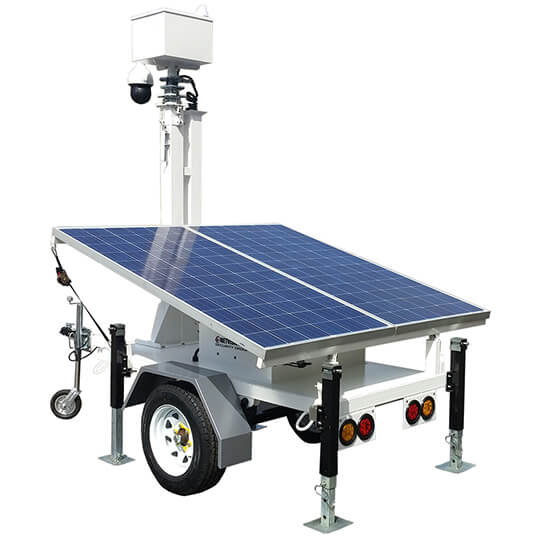
8 AI Detection Capabilities in Today’s Solar Surveillance Trailers

Most construction sites and remote facilities lose money after hours. Of course, there’s a fear of property trespassing, but with that, the chances of equipment theft and vandalism go up quite a bit, too. A study from the National Equipment Register (NER) confirms astonishing data. Almost $300 million to $1 billion in losses each year in the United States due to construction site theft. And the recovery rate at the same time is below 25%.
That is why solar surveillance trailers have evolved. They are no longer just mobile cameras on a pole. Today’s units are powered by AI detection capabilities that analyze video in real time, reduce false alarms, and send alerts within seconds. If you are evaluating solar surveillance solutions, these are the 8 AI detection capabilities that actually matter in 2026.
What Are Solar Surveillance Trailers?
Before jumping deeper into AI detection, it helps to understand the tool itself. So, what exactly is a solar surveillance trailer? In simple terms, it’s a mobile security system powered by solar energy. You tow it to a site, position it where visibility matters most, and it starts working.
Most trailers include high-definition cameras along with cellular connectivity and remote monitoring for better threat protection. This device works in places where permanent security infrastructure simply isn’t practical.
And here’s where things have changed recently. Older units mostly recorded footage. Useful, sure. But reactive. Today’s systems go further. Many modern solar surveillance trailers now integrate AI-driven detection, meaning the cameras don’t just watch, they analyze what’s happening.
1. Real-Time Intrusion Detection With AI Filtering
Traditional motion detection creates noise. Wind, shadows, animals, and moving branches trigger constant alerts. Modern AI detection systems use computer vision models trained to differentiate between:
- Humans
- Vehicles
- Animals
- Environmental motion
Instead of triggering on any movement, the AI classifies the object before sending an alert.
So why does this matter? Well, a 2022 industry report by the Security Industry Association found that up to 90% of traditional motion-based alarms are false positives. AI filtering reduces this dramatically, allowing security teams to focus only on verified threats.
On remote construction sites, this means you will see fewer unnecessary dispatches, a faster real incident response, and most importantly aower operational costs.
2. Vehicle Detection and License Plate Recognition
There are no less of vehicle thieves lurking near a construction site, and waiting for the right moment. There are several cases where thieves casually walked in and drove away an important vehicle in broad daylight. And while most outdated systems failed AI-powerd Solar surveillance trailers made history. This ultramodern system can detect and classify vehicles entering restricted zones. Advanced systems offer:
- Vehicle type detection (truck, van, sedan)
- Direction tracking
- License plate recognition (LPR)
- Time-stamped access logs
Another report from the National Insurance Crime Bureau says that suspects mostly use stolen vehicles for organized equipment theft rings. License plate analytics help investigators identify repeat offenders. The interesting fact, advanced license plate recognition systems are almost 95% accurate. And they can perfectly continue their work under optimal conditions.
3. Loitering and Suspicious Behavior Detection
Not every threat is immediate. Some incidents begin with loitering or scouting.
AI models can detect when a person:
- Remains in a restricted area beyond a defined time threshold
- Moves repeatedly along a perimeter fence
- Enters and exits multiple times
This type of detection is crucial for:
- Utility sites
- Solar farms
- Oil and gas facilities
- Outdoor event perimeters
Instead of waiting for forced entry, security teams receive alerts before damage occurs.
4. Perimeter Breach and Fence Climb Detection
Solar surveillance trailers are often deployed around temporary perimeters. AI-powered systems can detect:
- Fence climbing
- Gate breaches
- Restricted zone entry
- After-hours access
These detections rely on object tracking and boundary mapping within the camera’s field of view. According to OSHA and industry safety studies, construction site incidents often spike during off-hours. AI-based perimeter detection reduces response time by eliminating reliance on manual monitoring.
5. Weapon Detection and Threat Recognition
One of the most advanced capabilities now available is firearm detection. AI models trained on weapon datasets can identify lethal objects like guns, regardless of their size. Or brandished objects resembling firearms.
When deployed on solar surveillance trailers protecting high-risk environments, these alerts can trigger instant notifications and alarm sirens locally. At the same time, they try to contact law enforcement dispatch workflows. Weapon detection is particularly valuable for:
- Large outdoor events
- Critical infrastructure
- Remote industrial sites
Speed is critical. Modern AI systems can process frames in milliseconds, generating alerts within seconds.
6. Environmental and Safety Hazard Detection
Solar surveillance trailers are not just about theft prevention. They increasingly monitor safety compliance and environmental risks. AI systems can detect:
- Smoke and visible fire indicators
- Unauthorized vehicle access near hazardous zones
- Workers entering unsafe areas
According to the National Fire Protection Association, U.S. fire departments respond to over 37,000 fires annually in industrial or construction settings. Early detection through AI-powered cameras can reduce damage significantly. This capability transforms solar trailers into multi-purpose risk management tools, not just security cameras.
7. Edge AI Processing for Low-Bandwidth Environments
Many solar surveillance trailers operate in remote locations with limited connectivity. Modern systems use edge AI, meaning video is analyzed locally before alerts are sent. Only metadata or verified threat alerts are transmitted to the cloud. And this reduces:
- Bandwidth usage
- Data transmission costs
- Latency
It also ensures continued detection even if internet connectivity drops temporarily. For example, some enterprise-grade solar surveillance trailer platforms integrate edge-based detection. Such systems mainly use cloud verification to reduce false calls and provide fast alerts. However, Coram’s solar surveillance trailer are backed by AI-powered detection, rapid deployment, and cloud connectivity. And this allows teams to protect construction sites and outdoor assets without much of the hefty equipment and addons.
8. Multi-Site Centralized Alert Management
One solar surveillance trailer is helpful. Ten trailers across multiple job sites require coordination.
Modern AI systems allow:
- Centralized dashboards
- Real-time alert prioritization
- Cross-site monitoring
- Searchable video logs
According to industry security studies, centralized monitoring can reduce response time by up to 40% compared to decentralized site-based oversight.
For large contractors or infrastructure providers, this capability is often the deciding factor. Instead of hiring separate guards for every site, companies manage mobile AI units from one command center.
How AI Detection Is Replacing Traditional Guard Models
Security guard costs in the U.S. average $20 to $30 per hour, according to the U.S. Bureau of Labor Statistics. For 24/7 coverage, that can exceed $175,000 annually per site.
Solar surveillance trailers equipped with AI detection:
- Require no trenching
- Operate on renewable solar power
- Deploy within hours
- Reduce reliance on physical guards
This does not eliminate human oversight, but it shifts personnel from passive monitoring to active response.
What Makes a Solar Surveillance Trailer Truly “Smart”?
Not every mobile camera trailer qualifies as AI-powered. When evaluating solutions, look for:
- Verified human and vehicle detection
- License plate recognition capability
- Real-time cloud alerting
- Edge AI processing
- False alarm filtering
- Remote deployment without wired power
If the system relies solely on motion detection, it is outdated.
Key Takeaways
- Construction equipment theft costs up to $1 billion annually in the U.S.
- Traditional motion detection creates up to 90% false alarms
- AI filtering dramatically improves alert accuracy
- License plate recognition can exceed 95% accuracy in optimal conditions
- Edge AI reduces bandwidth and improves reliability
- Centralized monitoring can reduce response times by up to 40%
- Solar surveillance trailers now function as AI-driven security systems, not just mobile cameras
Conclusion: AI Is Redefining Mobile Security
Solar surveillance trailers have moved far beyond basic camera towers. Today’s systems use AI detection to analyze video in real time, verify threats, and reduce operational costs.
For construction firms, utilities, and event organizers, the decision is no longer whether to deploy mobile surveillance. It is whether the system you deploy can intelligently detect and classify risk before damage occurs.
AI detection is the difference between reacting to loss and preventing it.
As these technologies continue to evolve, the question becomes:
Are you using solar surveillance as passive recording, or as an active AI-driven defense system?
What detection capability do you think delivers the greatest ROI in your environment?
Read Also:
tags
Freddy Wosten
Freddy Wosten is a dynamic author. As a Blogging enthusiast and professional for the past 10+ years. And he is loving every bit of it. He lives in New York City. His niches are Business, Lifestyle, Tech, Real Estate, Finance, Travel, Social Media, Entertainment, and Multi-subjects. He is currently on Content Operations Senior Executive | to TechRab.com & MostValuedBusiness.com.


