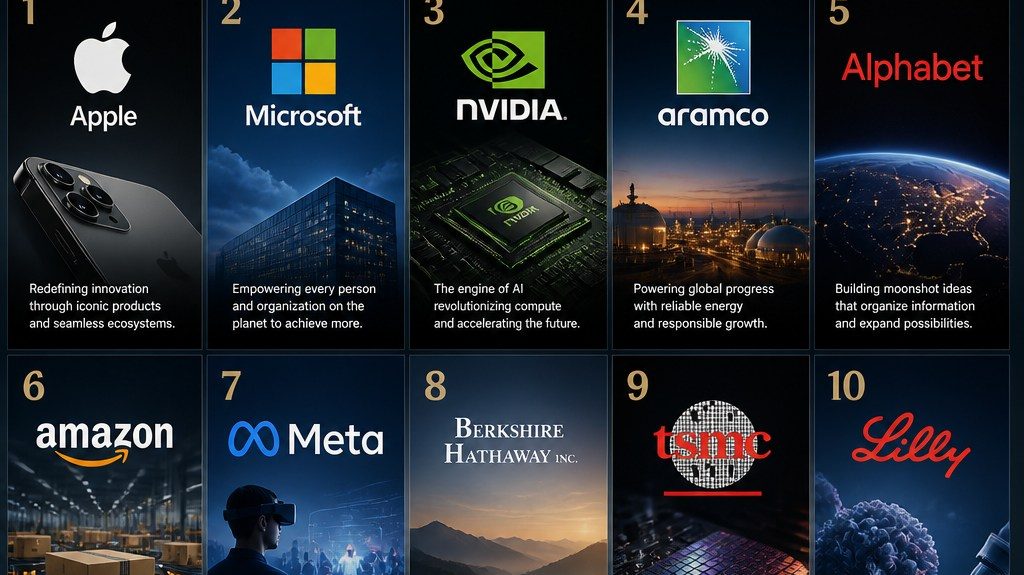
Most Valuable Business: 10 Businesses That Shape Markets, Industries, and Everyday Life

Although a high valuation looks impressive on a financial dashboard, numbers alone rarely explain why a company commands extraordinary market confidence. Usually, the most valuable business combines –
- Durable demand
- Strong leadership
- Pricing power
- Intellectual property
- Customer loyalty
- An ability to expand without losing strategic focus.
Market capitalization remains the standard measurement for comparing publicly traded companies. However, corporate value runs deeper. For instance, a business may –
- Control essential infrastructure
- Influence consumer behaviour
- Shape technological standards
- Own distribution networks that competitors cannot easily reproduce.
Consequently, the companies dominating global markets tend to possess economic advantages built over years (sometimes decades).
The following businesses represent more than financial scale. They demonstrate how modern corporate power develops and where leadership decisions matter. Also, they show why certain organisations remain difficult to displace.
Although rankings may shift as share prices move, the underlying business lessons stay remarkably consistent.
1. Apple: Turning Consumer Loyalty Into Corporate Power

Apple built its position through a rare combination of –
- Premium hardware
- Controlled software
- Brand discipline
- Customer retention.
Of course, many technology companies sell devices. But Apple sells an interconnected environment. This is where each product strengthens the usefulness of another. Once customers enter that environment, leaving becomes inconvenient.
That ecosystem creates predictable demand while supporting premium pricing. Moreover, Apple does not chase every available market simply because growth exists there. Instead, its leadership has traditionally preferred –
- Selective expansion
- Tight product portfolios
- Consistent design standards.
This restraint matters in the long run. In fact, corporate growth becomes complex when executives confuse activity with strategy.
Services have also reduced Apple’s dependence on hardware replacement cycles. App distribution, cloud storage, subscriptions, payments, warranties, and digital content generate recurring income from an established customer base. Therefore, Apple’s strength sits not only in selling devices but also in extending the commercial life of every customer relationship.
| What Makes Apple Valuable? Apple’s value lies in its ability to combine powerful branding with its integrated ecosystem. This helps ensure repeat purchases and long-term customer relationships. Apple has strong control over its hardware and software. The same is true for services and distribution. As a result, the brand switches costs and supports premium pricing simultaneously. The biggest advantage of this is not in its single product. Rather, it is the interconnected system. This helps the brand to provide value to its customers over time. |
2. Microsoft: Reinvention Without Abandoning the Core

Microsoft shows how a mature corporation reinvents itself without throwing away the assets that made it successful. The company moved from desktop software dominance into –
- Cloud computing
- Enterprise subscriptions
- Artificial intelligence
- Cybersecurity
- Gaming
- Professional networking.
Yet its core relationship with businesses remained intact.
The shift toward subscription-based products created steadier revenue and deeper customer dependence. Meanwhile, Azure placed Microsoft at the centre of corporate digital infrastructure.
That position carries serious strategic weight. This is because businesses do not replace cloud providers as casually as consumers replace mobile applications. To be honest, migration takes time, money, technical expertise, and executive approval.
Basically, Microsoft may qualify as the most valuable business from a strategic resilience perspective. This is because its products operate across several layers of corporate activity.
- Employees use its productivity tools
- Developers build through its platforms
- Executives purchase its cloud services
- Security teams rely on its protection systems.
Few competitors occupy so many rooms inside the same organisation.
| What Makes Microsoft Valuable? Microsoft’s products are deeply embedded in how organisations work. The following aspects reinforce one another and create high switching costs: ⦿ Productivity software ⦿ Cloud infrastructure ⦿ Cybersecurity ⦿ Development tools ⦿ Business services. Therefore, Microsoft’s greatest asset is not its technology. Rather, it is the long-standing position inside the daily operations of businesses. |
3. Nvidia: Owning the Bottleneck of the AI Economy
Nvidia’s rise reflects a basic rule of business value. When an industry changes rapidly, the company controlling the critical bottleneck mostly captures disproportionate rewards.
In fact, artificial intelligence requires enormous computing power. Moreover, Nvidia’s processors became central to training and operating advanced AI systems.
However, the company’s advantage does not come from chips alone. Its software ecosystem, developer relationships, technical expertise, and specialised platforms make its products harder to replace.
Of course, competitors might manufacture powerful processors. However, recreating years of software compatibility and developer familiarity requires a different level of expertise.
Nvidia also demonstrates the importance of leadership conviction. Long before generative AI became commercially fashionable, the company invested in accelerated computing.
That decision looked technical and somewhat narrow at first. Later, it became a defining corporate bet. To be honest, strategic foresight mostly works like that. It remains quiet for years. Then, it is suddenly obvious to everyone.
| What Makes Nvidia Valuable? Nvidia occupies a critical position in the AI computing ecosystem. Essentially, its advantage combines high-performance chips with – ⦿ Software ⦿ Developer support ⦿ Technical expertise ⦿ A mature platform that is difficult to reproduce quickly. This combination turns technological leadership into a broader strategic moat. |
4. Saudi Aramco: Scale Built on Essential Resources

Saudi Aramco occupies a different category from technology-led corporations. Its value comes from the following areas:
- Energy reserves
- Production capacity
- Operational scale
- Its central position within the global oil market.
While energy transitions continue, oil remains deeply connected to –
- Transportation
- Manufacturing
- Chemicals
- Aviation
- Industrial development.
The company benefits from access to large reserves and comparatively efficient production economics. As a result, it remains competitive during periods when lower oil prices pressure higher-cost producers.
Although this cost advantage provides resilience, geopolitical conditions and government ownership also shape its corporate profile.
Saudi Aramco’s position highlights an unfashionable but important point. Valuable businesses do not always create glamorous products. Sometimes they control resources that the global economy still cannot function without.
Moreover, demand may evolve, and policy may tighten. Still, essential supply retains considerable negotiating power.
| What Makes Saudi Aramco Valuable? Saudi Aramco combines enormous resource access with production scale. Also, it has relatively strong cost economics. In fact, its importance extends beyond the company itself. This is because oil remains fundamental to – ⦿ Transportation ⦿ Manufacturing ⦿ Chemicals ⦿ Aviation ⦿ Industrial activity. What creates substantial strategic value is its control of an essential resource combined with the ability to produce it efficiently at scale. |
5. Alphabet: Converting Information into Commercial Infrastructure
Although Alphabet’s strength begins with Google Search, it does not end there. Search captures user intent at precisely the moment someone wants –
- Information
- A product
- A service
- A solution.
In fact, advertisers value that intent. This is because it sits closer to action than broad, untargeted attention.
Beyond advertising, Alphabet operates the following areas:
- Video platforms
- Mobile software
- Cloud infrastructure
- Mapping services
- Productivity tools
- Artificial intelligence research
In fact, each asset produces data, distribution, or technical capability that strengthens the wider organisation. Consequently, Alphabet tests new services against a global user base that most start-ups could only dream about.
Still, scale creates complications. For instance, the following aspects remain serious concerns:
- Regulatory scrutiny
- Changing search habits
- Artificial intelligence competition
- Advertising dependence.
Alphabet’s leadership challenge involves protecting a highly profitable core. Meanwhile, it allows new technologies to disrupt existing habits. However, it is easier said than done, especially when the old model still prints money.
| What Makes Alphabet Valuable? Primarily, Alphabet controls a global information and digital distribution infrastructure. This infrastructure is built around – ⦿ Search ⦿ Advertising ⦿ Android ⦿ YouTube ⦿ Maps ⦿ Cloud ⦿ Emerging AI capabilities. Search provides unusually valuable insight into user intent. Meanwhile, the broader ecosystem generates data, reach, and technological capabilities. Those aspects reinforce the business. Its scale allows Alphabet to turn attention and information into multiple commercial opportunities. |
6. Amazon: Building the Infrastructure Behind Convenience

Although Amazon began with online retail, its deeper achievement involved converting logistics and computing infrastructure into competitive weapons. In this case, the following factors created an organisation with several overlapping growth engines:
- Warehouses
- Fulfilment systems
- Delivery networks
- Merchant services
- Advertising tools
- Cloud computing.
Although retail gives Amazon enormous customer reach, it operates with tighter margins than many technology businesses.
Moreover, Amazon Web Services provides a more profitable foundation by supporting –
- Websites
- Applications
- Corporate systems
- Digital products.
In effect, Amazon earns from both visible consumer activity and the less visible infrastructure operating behind the internet.
The company also understands habit formation. With Amazon, the following benefits reduce the reasons customers might shop elsewhere:
- Fast delivery
- Broad selection
- Simple payments
- Membership benefits.
Accordingly, convenience becomes a moat. It is a stubborn moat that grows stronger whenever consumers decide saving ten minutes matters.
| What Makes Amazon Valuable? In the last decade, Amazon has transformed convenience into a large-scale economic advantage. The following aspects of Amazon create multiple sources of revenue: ⦿ Logistics network ⦿ Fulfilment infrastructure ⦿ Marketplace ⦿ Advertising business ⦿ AWS platform Meanwhile, they reinforce customer and merchant dependence. As a result, its physical and digital infrastructure becomes more valuable as more activity flows through it. |
7. Meta Platforms: Monetising Global Attention

Meta built its economic position through –
- Messenger.
These platforms operate at extraordinary scale. As a result, they give the company access to –
- Social interaction
- Creator activity
- Business communication
- Digital advertising demand across diverse markets.
Meta’s advertising system allows companies to target audiences. Also, they can measure performance with greater precision than many traditional media channels.
Furthermore, network effects strengthen platforms. In fact, users remain because friends, communities, creators, and businesses already participate. That circular advantage makes direct competition expensive and uncertain.
However, Meta must constantly respond to shifting user behaviour.
- Younger audiences adopt new formats
- Privacy restrictions affect targeting
- Regulators question platform influence.
Therefore, leadership cannot rely on installed scale alone. So, the business must keep rebuilding relevance. Meanwhile, it must protect the advertising engine funding its larger technological ambitions.
| What Makes Meta Valuable? Meta’s platforms connect billions of users, creators, and businesses within powerful network effects. As a result, it has an enormous audience. This creates a highly scalable advertising business. Meanwhile, the interactions within those platforms provide valuable signals for targeting and engagement. Therefore, the key asset is the network itself. The size and participation make the ecosystem difficult to replicate. |
8. Berkshire Hathaway: Value Through Capital Allocation
Berkshire Hathaway differs sharply from platform companies and semiconductor leaders. It operates as a diversified holding company with interests in –
- Insurance
- Railways
- Energy
- Manufacturing
- Retail
- Major public corporations.
Its defining capability lies in capital allocation rather than product innovation.
While insurance operations provide investable funds, owned businesses generate cash that leadership can redirect toward one of the following –
- Acquisitions
- Securities
- Share repurchases
- Internal expansion.
This structure gives Berkshire flexibility across economic cycles. When markets become overheated, patience protects capital. So, when opportunities appear, liquidity becomes a competitive advantage.
Berkshire’s history also shows why managerial culture matters. Subsidiaries mostly retain operational independence. This reduces unnecessary bureaucracy. At the same time, central leadership remains disciplined about financial returns.
Although the model sounds simple, maintaining trust, restraint, and rational decision-making across decades is difficult in practice.
| What Makes Berkshire Hathaway Valuable? Berkshire Hathaway has a unique ability to allocate capital intelligently across a diversified collection of businesses and investments. The factors that give it flexibility are its: ⦿ Insurance operations ⦿ Substantial cash resources ⦿ Decentralised management structure ⦿ Disciplined financial culture. The central advantage is its ability to move capital toward its highest-value opportunities. Meanwhile, it preserves long-term financial strength. |
9. TSMC: Manufacturing at the Edge of Possibility

Taiwan Semiconductor Manufacturing Company manufactures advanced chips for many of the world’s leading technology businesses. Although its customers design processors, TSMC provides –
- The facilities
- Engineering knowledge
- Production precision required to manufacture them at massive scale.
In general, semiconductor fabrication demands enormous investment and relentless technical improvement. Also, a new manufacturing facility can cost billions before producing commercial returns. In addition, microscopic production errors might damage yields and reduce profitability.
TSMC’s process expertise therefore acts as a powerful barrier against less experienced competitors.
The company’s importance also creates geopolitical risk. Its manufacturing concentration makes supply security a concern for governments and customers alike.
Even so, that vulnerability does not erase its strategic value. Instead, it proves how one highly specialised corporation becomes essential to industries ranging from smartphones to automobiles and artificial intelligence.
| What Makes TSMC Valuable? At the outset, TSMC’s advanced semiconductor manufacturing requires – ⦿ Extraordinary capital ⦿ Technical expertise ⦿ Precision ⦿ Accumulated process knowledge. TSMC can manufacture increasingly sophisticated chips at scale. This aspect makes it a critical partner for companies that design products but cannot easily reproduce the manufacturing capability themselves. Therefore, its value comes from specialised expertise that is exceptionally difficult and expensive to replicate. |
10. Eli Lilly: Creating Value Through Scientific Productivity

Eli Lilly represents the growing corporate power of pharmaceutical innovation. Drug development involves –
- Lengthy research cycles
- Regulatory scrutiny
- Substantial financial risk
- Frequent failure.
However, successful treatments generate strong demand. Meanwhile, it addresses health conditions affecting millions of people.
The company’s value reflects confidence in its –
- Product portfolio
- Research pipeline
- Manufacturing capacity
- Ability to commercialise complex therapies.
Unlike consumer brands, pharmaceutical businesses cannot rely mainly on persuasive marketing. In fact, the following factors determine whether innovation becomes revenue:
- Clinical outcomes
- Regulatory approvals
- Medical adoption
- Supply reliability.
Still, scientific success must translate into responsible corporate execution. For instance, manufacturing shortages, affordability concerns, patent expiration, and competition might complicate an attractive growth story.
Consequently, pharmaceutical leadership requires more than research ambition. It requires operational discipline and stakeholder awareness. Also, it requires careful long-term investment.
| What Makes Eli Lilly Valuable? Eli Lilly’s successful pharmaceutical innovation generates massive demand while creating long-lived intellectual property and commercial opportunities. The following aspects of Eli Lilly work together as a system: ⦿ Its research pipeline ⦿ Clinical capabilities ⦿ Manufacturing capacity ⦿ Ability to bring complex therapies to market. Its value lies in the conversion of scientific breakthroughs into reliable, scalable products. Those later on meet substantial medical needs. |
Comparison of the Most Valuable Businesses
| Business | Primary Value Driver | Strategic Advantage | Central Leadership Challenge |
| Apple | Premium consumer ecosystem | Brand loyalty and integrated products | Sustaining innovation at enormous scale |
| Microsoft | Enterprise software and cloud | Customer dependence across workflows | Managing expansion without fragmentation |
| Nvidia | AI computing infrastructure | Hardware and software integration | Defending leadership as competition increases |
| Saudi Aramco | Energy production | Resource scale and cost efficiency | Navigating transition and geopolitical pressure |
| Alphabet | Search and digital advertising | Data, distribution, and user intent | Adapting the core business to AI |
| Amazon | Commerce, logistics, and cloud | Infrastructure depth and convenience | Balancing growth with operating efficiency |
| Meta Platforms | Social platforms and advertising | Global network effects | Maintaining relevance and public trust |
| Berkshire Hathaway | Diversified ownership | Capital allocation and patient liquidity | Managing leadership continuity |
| TSMC | Semiconductor manufacturing | Technical expertise and production scale | Reducing geographic and supply-chain risk |
| Eli Lilly | Pharmaceutical innovation | Research pipeline and intellectual property | Expanding access while protecting returns |
What Separates Valuable Businesses From Popular Companies
A popular company may attract attention for a season. Meanwhile, a valuable company turns the following aspects into repeatable economic returns:
- Attention
- Infrastructure
- Expertise
- Resources.
That distinction matters because publicity can disappear quickly. On the other hand, an embedded competitive advantage usually erodes more slowly.
Several characteristics repeatedly appear among value leaders:
1. They Control Something Difficult to Reproduce
That asset may involve –
- Technology
- Distribution
- Manufacturing expertise
- Intellectual property
- Natural resources
- Deeply established customer relationships.
2. They Reinvest Before Urgency Arrives
Strong leaders invest in future capabilities. Meanwhile, the existing business is still performing well, rather than waiting for disruption to make change unavoidable.
3. They Create Multiple Routes to Revenue
Their core products mostly support –
- Subscriptions
- Services
- Advertising
- Infrastructure
- Financing
- Complementary offerings.
4. They Convert Scale into Efficiency
Size alone creates complexity. In fact, the better organisations use size to –
- Reduce costs
- Improve data quality
- Expand distribution
- Strengthen their negotiating power.
Ultimately, the most valuable business operates with some form of strategic asymmetry. It might do something faster, cheaper, more reliably, or at a scale that rivals struggle to match.
Without that asymmetry, valuation becomes vulnerable to –
- Fashion
- Optimism
- Temporary market enthusiasm.
Corporate Value Comes from Strategic Depth
The world’s leading corporations did not become dominant through a single product launch or an isolated year of strong financial performance. Rather, they built systems.
While some created ecosystems, others controlled infrastructure. Meanwhile, a few mastered the following:
- Capital allocation
- Scientific innovation
- Manufacturing
- Essential resources.
Markets will continue to reorder these companies as technology changes, regulations tighten, and consumer expectations evolve.
Nevertheless, the central lesson remains stable. The most valuable business is rarely the company making the loudest announcement. In most cases, it is the organization quietly controlling a crucial layer of economic activity. Moreover, it is strengthening that position year after year.
For executives, founders, and investors, valuation should therefore serve as an outcome rather than the primary objective. Ultimately, durable value grows from –
- Disciplined leadership
- Intelligent reinvestment
- Operational consistency
- A clear understanding of where genuine competitive power sits.
To be honest, the numbers arrive later, usually after the difficult work.
Frequently Asked Questions (FAQs)
1. What Defines a Valuable Business?
A valuable business combines the following aspects:
- Sustainable demand
- Strong cash generation
- Capable leadership
- Competitive advantages
- Operational resilience
- Credible opportunities for long-term expansion.
2. Is Market Capitalisation the Same as Business Value?
No. Basically, market capitalisation reflects equity market value. Meanwhile, broader business value may include –
- Debt
- Assets
- Cash flows
- Strategic influence
- Private ownership.
3. Why Are Technology Companies Mostly Highly Valued?
Technology companies are highly valued because they –
- Scale rapidly
- Serve global markets
- Generate recurring revenue
- Collect valuable data
- Expand without proportionally increasing operating costs.
4. Does a Private Company Become More Valuable Than a Public Company?
Of course, private companies achieve enormous valuations. However, limited financial disclosure and infrequent funding rounds make direct comparisons less transparent and precise.
5. What Is the Biggest Risk Facing Highly Valued Companies?
Complacency presents a major risk. This is because dominant companies may overlook –
- Changing customer behaviour
- Disruptive technologies
- Regulatory pressure
- Increasingly capable competitors.
Read Also:
- How To Start A Business? – The Most Valued Question Budding Entrepreneurs Ask
- Valuing A Business: What Is Business Valuation & Why Is It Important?
- How To Become A Master Of Amazon Reselling & Generate Maximum Profit?
- Apple Is ‘Behind The Curve’ On Generative AI: Analyst
- Tips For Ethical Business Management
tags
Soumava Goswami
Soumava Goswami is a Content Strategist with 7+ years of experience in creating and strategizing helpful and user-focused content across business, marketing, leadership, and finance. With a strong background in literature and philosophy, Soumava uses memorable characters, narratives, and timeless ideas to make complex corporate concepts easier to understand. Inspired by The Social Network and shaped by his experience with a small MarTech company, he enjoys studying successful businesses. Also, he translates their strategies into practical guidance on leadership, decision-making, customer feedback, operations, and sustainable growth. LinkedIn