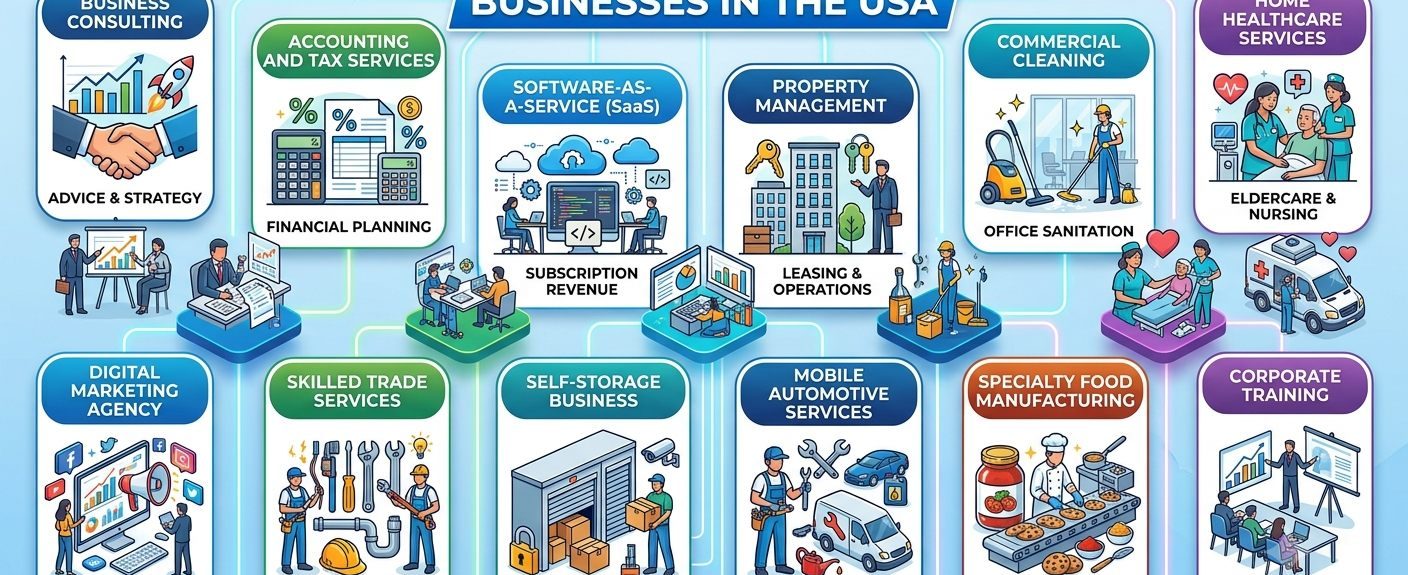
12 High-Margin Business Models Built for the American Market

Profitability does not always begin with a flashy idea. Usually, it starts with something like:
- Reliable demand
- Sensible pricing
- Controlled overhead
- Customers who keep returning.
The most profitable businesses in the USA tend to combine these fundamentals. They do not chase revenue without understanding where the money actually goes.
Still, “profitable” does not mean effortless. Although some businesses generate impressive margins, they require rare expertise. Others produce steady cash flow while demanding substantial equipment, staffing, or regulatory investment.
Therefore, the right opportunity depends on –
- Capital availability
- Leadership capability
- Local competition
- The owner’s tolerance for operational complexity.
Quick Comparison of Profitable Business Models
The following list focuses on business models with –
- Strong profit potential
- Practical scalability
- Durable demand.
- No inflated promises.
- No overnight-success stuff.
Just commercially sound opportunities that can work when management remains disciplined.
| Business Model | Startup Cost | Margin Potential | Scalability | Operational Difficulty |
| Business consulting | Low | Very high | High | Medium |
| Accounting and tax services | Low to medium | High | High | Medium |
| Software-as-a-service | Medium to high | Very high | Very high | High |
| Property management | Medium | High | High | High |
| Commercial cleaning | Low to medium | Moderate to high | High | Medium |
| Home healthcare services | Medium to high | High | High | Very high |
| Digital marketing agency | Low | High | High | Medium |
| Skilled trade services | Medium | High | Medium | High |
| Self-storage business | High | High | Medium | Medium |
| Mobile automotive services | Medium | High | Medium | Medium |
| Specialty food manufacturing | Medium to high | Moderate to high | High | High |
| Corporate training | Low | High | High | Medium |
Also check & read: Most Profitable Industries in the United States
1. Business Consulting

Business consulting can deliver exceptional margins. This is because the primary asset is expertise rather than physical inventory. In this case, consultants help companies –
- Improve operations
- Reduce costs
- Enter new markets
- Manage change
- Strengthen leadership.
Consequently, a specialist with credible experience can charge substantially more than a broad, general-purpose advisor.
The strongest consulting firms do not sell vague advice. Instead, they package clear outcomes. In general, these include –
- Reducing procurement expenses
- Redesigning sales processes
- Preparing an organization for expansion.
Moreover, retainer agreements can stabilize cash flow. Meanwhile, workshops, diagnostic tools, and digital products create additional revenue without matching every dollar to another billable hour.
However, reputation carries most of the commercial weight. For instance, a shallow service proposition gets exposed quickly. In fact, successful consultants need –
- Proof
- A defined methodology
- Strong executive communication
- Enough confidence to challenge senior decision-makers when the situation calls for it.
Major Companies Following This Business Model
| Company | What They Do |
| McKinsey & Company | Charges premium fees for strategy and organizational change, not physical products. |
| Boston Consulting Group | Builds retainer relationships around measurable outcomes like cost reduction. |
| Bain & Company | Packages proprietary frameworks into repeatable, high-margin engagements. |
| Deloitte Consulting | Combines advisory work with digital products to reduce hourly dependence. |
2. Accounting and Tax Services

Every serious business needs –
- Accurate books
- Tax preparation
- Payroll support
- Financial reporting.
That recurring necessity gives accounting firms a stable commercial base. This works even when economic conditions become uncertain. Moreover, monthly bookkeeping packages might produce predictable revenue rather than seasonal, one-off transactions.
In fact, profitability improves when firms move beyond basic data entry. For instance, the following roles command higher fees because they influence business decisions:
- Advisory services
- Cash-flow forecasting
- Industry-specific reporting
- Fractional controller support
Although automation can handle routine work, clients still value judgment when financial choices become complex or high stakes.
Meanwhile, trust remains the real product. For instance, missed deadlines, weak controls, or careless communication damage client relationships fast.
Therefore, firms must build documented processes and review systems. This way, they will outperform operators who rely entirely on personal memory.
Major Companies Following This Business Model
| Company | What They Do |
| Deloitte | Serves enterprise clients through recurring audit, tax, and advisory contracts. |
| PwC | Bundles compliance work with higher-margin financial advisory services. |
| EY | Builds long-term client trust through documented, standardized processes. |
| H&R Block | Monetizes recurring, high-volume tax preparation at consumer scale. |
Also read: How To Calculate Business Taxes?
3. Software-as-a-Service Products
Software-as-a-service businesses scale without increasing costs at the same rate as revenue. Once the product works, additional customers may require support and infrastructure. However, they do not require an entirely new production cycle.
That economic structure explains why SaaS remains among the Most Profitable Businesses in the USA. It is profitable for founders who solve a meaningful, recurring problem.
Niche software often has a better opening than a broad consumer application. For instance, the following can address specific frustrations:
- A scheduling platform for dental clinics
- A compliance dashboard for contractors
- An inventory tool for regional distributors.
More importantly, specialized users may stay longer. This is because switching systems creates disruption.
Nevertheless, the model is not automatically profitable. For instance, the following tasks consume cash:
- Product development
- Cybersecurity
- Customer acquisition
- Onboarding
- Ongoing improvements.
Usually, the winning formula is:
- Narrow positioning
- Reliable performance
- Low customer churn
- Pricing tied to measurable business value.
Major Companies Following This Business Model
| Company | What They Do |
| Salesforce | Scales customer relationships through subscription pricing, not one-time sales. |
| HubSpot | Grows revenue per account without a matching rise in production cost. |
| Toast | Solves a narrow, recurring problem for a specific industry (restaurants). |
| Procore | Retains niche users by embedding into daily construction workflows. |
4. Property Management

In many cases, property owners want rental income without handling –
- Tenant communication
- Inspections
- Maintenance problems
- Late-night emergencies.
Property management companies absorb that burden. Also, it usually earns recurring fees based on –
- Rent collected
- Units managed
- Service packages.
Scale changes the economics significantly. For instance, a small portfolio may feel chaotic. This is because each issue demands immediate attention. Meanwhile, a larger operation might justify –
- Dedicated leasing staff
- Maintenance coordination
- Standardized technology.
In addition, the following aspects might expand revenue per property:
- Tenant placement
- Inspection services
- Maintenance administration.
Even so, this business punishes disorder. In fact, managers must –
- Understand landlord-tenant requirements
- Document interactions
- Supervise vendors
- Respond quickly when habitability issues arise.
In general, strong systems matter more than charm. Frankly, a friendly manager with poor records might become an expensive liability.
Major Companies Following This Business Model
| Company | What They Do |
| Greystar | Earns recurring fees by managing large residential portfolios at scale. |
| CBRE Property Management | Standardizes technology and staffing to manage more units efficiently. |
| Cushman & Wakefield | Expands revenue per property through bundled service packages. |
| Real Property Management | Applies the same fee-based model through a regional franchise structure. |
Read also: An Overview of Wealth Management and Effective Strategies
5. Commercial Cleaning Services

Although commercial cleaning lacks glamour, it offers repeat demand and relatively manageable entry costs. For instance, offices, medical facilities, warehouses, schools, and retail properties need dependable cleaning regardless of changing consumer trends.
In fact, contracts might run monthly or annually. This creates a recurring foundation for cash flow.
The attractive part is not merely cleaning buildings. Rather, it is building a route-dense operation with –
- Trained teams
- Controlled supply expenses
- Consistent quality checks.
Once crews travel efficiently between nearby locations, labor utilization improves. Then, management can serve more accounts without unnecessary downtime.
Meanwhile, price competition remains aggressive. So, underbidding becomes a common trap. Instead, better operators differentiate through –
- Compliance
- Reliability
- Specialized sanitation
- Transparent reporting.
In fact, a missed cleaning job sounds minor until it threatens a client’s opening time or workplace standards.
Major Companies Following This Business Model
| Company | What They Do |
| ABM Industries | Secures long-term contracts with offices, schools, and medical facilities. |
| Jani-King | Builds a franchise network around route-dense, recurring cleaning contracts. |
| ServiceMaster Clean | Differentiates through compliance and consistent quality checks. |
6. Home Healthcare Services

The following aspects support the growth of home healthcare and non-medical assistance businesses:
- An aging population
- Longer life expectancy
- Demand for care at home
In general, services include the following:
- Companionship
- Mobility support
- Meal preparation
- Medication reminders
- Licensed clinical care
However, those services depend on the provider’s credentials and state requirements.
In many cases, revenue can become recurring. This is because clients mostly need ongoing support rather than a single appointment. Furthermore, referral relationships are necessary with the following entities:
- Hospitals
- Physicians
- Rehabilitation centers
- Community organizations.
Those relationships might reduce dependence on broad consumer advertising.
Still, this is a responsibility-heavy operation. For instance, the following issues can pressure margins:
- Staffing shortages
- Caregiver turnover
- Scheduling gaps
- Insurance requirements
- Regulatory oversight.
In fact, leadership must treat workforce quality as a strategic issue rather than an administrative chore. In this field, poor hiring creates both financial risk and real human consequences.
Major Companies Following This Business Model
| Company | What They Do |
| Amedisys | Converts ongoing patient care into recurring, contract-based revenue. |
| LHC Group | Relies on hospital and physician referrals to reduce acquisition costs. |
| Home Instead | Treats caregiver recruitment and retention as a core strategic priority. |
7. Digital Marketing Agencies
As businesses grow, they continue to need –
- Search visibility
- Paid advertising
- Email campaigns
- Content
- Conversion optimization
- Performance reporting.
In fact, a focused digital marketing agency will provide those capabilities through –
- Monthly retainers
- Project fees
- Outcome-linked pricing.
Moreover, specialization usually strengthens margins. For instance, an agency serving law firms, construction companies, or healthcare practices might develop repeatable campaigns and industry knowledge. As a result, it spends less time rebuilding its delivery model for every client. This way, it becomes easier to position itself in a crowded market.
However, revenue concentration creates danger. In fact, losing one large account might reshape the entire month. Therefore, agencies should maintain –
- Healthy client diversification
- Realistic reporting
- Standardized delivery processes.
Although vanity metrics may impress briefly, executives eventually ask what the campaign contributed to revenue.
Major Companies Following This Business Model
| Company | What They Do |
| WPP | Operates at holding-company scale across multiple specialized agencies. |
| Publicis Groupe | Uses outcome-linked pricing tied to measurable client performance. |
| Omnicom | Diversifies across clients and industries to limit revenue concentration. |
| Wpromote | Specializes by industry to shorten delivery time and raise margins. |
8. Skilled Trade Services
HVAC repair, plumbing, electrical work, roofing, and specialized maintenance remain commercially powerful. This is because customers cannot postpone every urgent problem.
In fact, a failed heating system or burst pipe creates immediate demand. Moreover, qualified operators can charge for skill, speed, and reliability.
These businesses also benefit from –
- Maintenance contracts
- Emergency call-out fees
- Relationships with property managers or commercial facilities.
Over time, one successful repair might lead to recurring inspections and replacement projects. Therefore, customer lifetime value may extend well beyond the first service visit.
Usually, the constraint is labor rather than demand. While recruiting qualified technicians is difficult, weak scheduling wastes productive hours.
So, instead of treating technicians as interchangeable labor, profitable trade companies invest in –
- Apprenticeships
- Dispatch software
- Safety standards
- Field leadership.
Major Companies Following This Business Model
| Company | What They Do |
| ARS/Rescue Rooter | Converts emergency call-outs into long-term maintenance contracts. |
| Roto-Rooter | Charges a premium for speed and reliability during urgent repairs. |
| Mister Sparky | Uses dispatch software and franchising to scale labor efficiently. |
9. Self-Storage Facilities

Self-storage might produce recurring monthly revenue with fewer employees than many service businesses require. In fact, customers use units during –
- Moves
- Renovations
- Divorces
- Business transitions
- General space shortages.
Although those life events keep demand relatively broad, local conditions still decide whether a facility thrives.
After land acquisition and construction, operating costs can remain comparatively controlled. The following factors also reduce staffing needs:
- Automated access
- Online rentals
- Security systems
- Remote customer support
In addition, operators may sell locks, packing materials, insurance-related products, or vehicle storage.
Moreover, location analysis cannot be skipped. Building in an oversupplied market will trap capital for years. So, before touching a construction plan, the strongest operators study –
- Household growth
- Nearby competition
- Rental rates
- Occupancy patterns
- Visibility
- Zoning.
Major Companies Following This Business Model
| Company | What They Do |
| Public Storage | Generates recurring monthly revenue with a lean, automated staffing model. |
| Extra Space Storage | Studies household growth and occupancy trends before building new sites. |
| CubeSmart | Reduces staffing costs through online rentals and remote customer support. |
10. Mobile Automotive Services
At the outset, the following services bring the service directly to the customer:
- Mobile detailing
- Tire replacement
- Battery installation
- Minor repairs
- Fleet maintenance.
Moreover, convenience supports premium pricing. This holds particularly for busy professionals and commercial fleets that lose money when vehicles sit idle.
Compared with a full repair shop, a mobile operation may carry lower property expenses. Also, scheduling technology helps group appointments geographically. This protects technician time and fuel costs. Better yet, fleet contracts turn irregular consumer demand into predictable business-to-business revenue.
Meanwhile, the following factors still affect performance:
- Weather
- Travel time
- Equipment limitations
- Technician reliability.
Therefore, operators need firm service boundaries and practical routing rules. Accepting every job across a huge territory may increase booked revenue while quietly destroying actual profit.
Major Companies Following This Business Model
| Company | What They Do |
| Wrench | Brings repair and maintenance directly to customers for a convenience premium. |
| YourMechanic | Uses scheduling technology to group appointments and protect technician time. |
| Spiffy | Converts fleet contracts into predictable, business-to-business revenue. |
11. Specialty Food Manufacturing

Specialty food manufacturing can succeed when the product –
- Occupies a clear category
- Solves a dietary concern
- Carries meaningful regional appeal.
For instance, sauces, snack foods, baked products, frozen meals, and premium ingredients reach customers through retailers, distributors, restaurants, or direct online sales.
Unlike local food service, manufacturing creates room for wider geographic expansion. Still, profitability depends on unit economics. In this case, the following aspects might eat through revenue before management notices the problem:
- Packaging
- Ingredients
- Spoilage
- Freight
- Retailer margins
- Promotional allowances.
Accordingly, disciplined founders start with a limited product range and test repeat purchasing. Although shelf presence looks exciting, inventory that does not move becomes expensive decoration. In fact, operational focus matters more than a bloated catalog.
Major Companies Following This Business Model
| Company | What They Do |
| Chobani | Started with a narrow product category before expanding distribution widely. |
| Clif Bar | Proved repeat purchasing on a limited range before broadening its catalog. |
| KIND Snacks | Reached retailers and distributors after building direct customer demand. |
12. Corporate Training and Leadership Development

Many companies routinely invest in –
- Management development
- Communication
- Sales capability
- Compliance
- Technical upskilling.
So, corporate trainers can deliver programs through –
- Workshops
- Virtual sessions
- Learning platforms
- Long-term leadership academies.
Margins become attractive when intellectual property gets reused. For instance, a well-designed program serves multiple clients with targeted adjustments rather than complete reinvention. Moreover, licensing materials or training internal facilitators creates scale beyond the founder’s personal calendar.
Furthermore, credibility remains essential. This is because corporate buyers expect business outcomes rather than motivational theatre. So, programs should connect learning to –
- Behavior
- Performance
- Risk reduction.
Although procurement cycles may move slowly, strong enterprise relationships produce repeat engagements across departments and locations.
Major Companies Following This Business Model
| Company | What They Do |
| FranklinCovey | Licenses reusable frameworks and certifies facilitators to scale beyond the founder. |
| Dale Carnegie | Builds repeat enterprise engagements across departments and locations. |
| Skillsoft | Delivers programs through scalable learning platforms rather than in-person-only sessions. |
What Makes These Businesses Consistently Profitable?
Across the list, several patterns appear. Usually, profitable companies solve recurring problems, not occasional curiosities. They also protect pricing by offering expertise, convenience, reliability, or measurable economic value rather than competing only on cost.
So, a strong operating model generally includes:
- Recurring or contract-based revenue that improves predictability.
- Clear customer acquisition economics and controlled overhead.
- Documented workflows that reduce dependence on one person.
- Pricing based on –
- Value
- Complexity
- Risk.
- Enough specialization to build authority without shrinking the market excessively.
Moreover, leadership quality changes the result. For instance, a promising market cannot rescue –
- Poor cash-flow management
- Uncontrolled hiring
- Confused positioning.
Meanwhile, an ordinary-looking industry might produce an excellent company when managers understand capacity, customer retention, and process discipline.
Choosing the Right Business Requires More Than Chasing Margins
The Most Profitable Businesses in the USA are not necessarily the easiest businesses to launch. In fact, high margins may conceal –
- Licensing barriers
- Long sales cycles
- Technical demands
- Expensive customer acquisition.
Consequently, entrepreneurs should evaluate the complete operating picture before committing capital.
Basically, the best choice sits where market demand meets genuine capability. For instance, a founder with healthcare experience may handle compliance better than software development. Likewise, an experienced technician may build a stronger trade company than a generic online store.
Ultimately, sustainable profit comes from repeatable execution. To create businesses that will survive beyond the original enthusiasm, leaders must:
- Monitor cash flow
- Retain capable employees
- Price with confidence
- Build reliable systems.
That is the real game. It is not about merely starting. Rather, it is about building something commercially durable.
Frequently Asked Questions (FAQs)
1. Which Business Has the Highest Profit Potential in the USA?
In most cases, the following businesses produce high margins:
- Software
- Specialized consulting
- Financial services.
However, actual profitability lies in –
- Expertise
- Customer retention
- Disciplined cost control.
2. What Is the Most Profitable Low-Cost Business to Start?
The following businesses are possible to start with low capital:
- Consulting
- Digital marketing
- Bookkeeping
- Corporate training.
This is because they primarily monetize –
- Specialized knowledge
- Relationships
- Professional capability.
3. How Long Does a New Business Take to Become Profitable?
Profitability may take several months or multiple years, depending on –
- Startup costs
- Pricing
- Sales cycles
- Operating efficiency
- The founder’s available capital.
4. What Should Entrepreneurs Analyze Before Choosing a Business?
At the outset, entrepreneurs should assess –
- Demand
- Competition
- Regulation
- Startup capital
- Recurring revenue potential
- Operational complexity
- Labor availability
- Their own industry-specific strengths.
5. Are Service Businesses More Profitable Than Product Businesses?
Service businesses mostly require less inventory and capital. Meanwhile, product businesses may scale further when manufacturing, distribution, and customer acquisition remain efficient.
Read Also:
tags
Soumava Goswami
Soumava Goswami is a Content Strategist with 7+ years of experience in creating and strategizing helpful and user-focused content across business, marketing, leadership, and finance. With a strong background in literature and philosophy, Soumava uses memorable characters, narratives, and timeless ideas to make complex corporate concepts easier to understand. Inspired by The Social Network and shaped by his experience with a small MarTech company, he enjoys studying successful businesses. Also, he translates their strategies into practical guidance on leadership, decision-making, customer feedback, operations, and sustainable growth. LinkedIn