Types of Corporations Explained: Which One Actually Fits Your Business?

At the outset, a corporation is a legal entity that individuals and shareholders create by converting their business structure. The motivation behind forming a corporation is profit. By creating a corporation, the business owners become free from the legal liability of the business.
The corporation by itself gets the permission to –
- Enter into contracts
- Own assets
- Remit federal and state taxes
- Even borrow money from banks.
However, picking the right structure isn’t just paperwork. It changes –
- How you’re taxed
- How exposed you are personally if something goes wrong
- How easily you can bring in investors down the line.
That’s why understanding the different types of corporations matters more than most founders realize when they’re staring at incorporation forms for the first time.
What Is A Corporation?
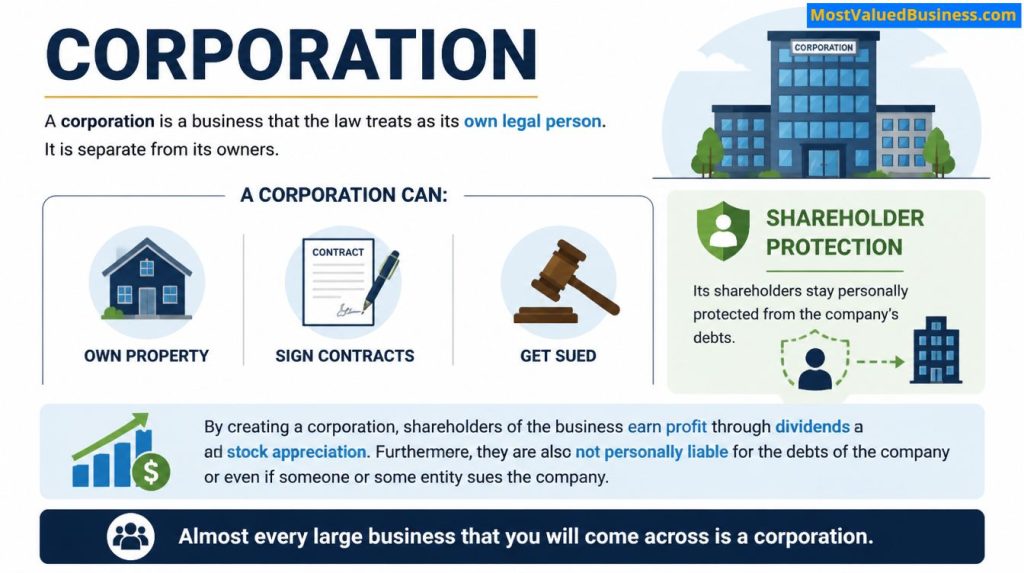
Primarily, a corporation is a business that the law treats as its own legal person. It is separate from its owners. Basically, it can –
- Own property
- Sign contracts
- Get sued.
Meanwhile, its shareholders stay personally protected from the company’s debts.
By creating a corporation, shareholders of the business earn profit through dividends and stock appreciation. Furthermore, they are also not personally liable for the debts of the company or even if someone or some entity sues the company. Almost every large business that you will come across is a corporation.
Some of the major examples of corporations include Microsoft Corp., Coca-Cola Co., and many more. Some corporations even do business under one name and a corporation under another, which is the case with Google (Alphabet Inc.).
How To Form A Corporation (Choosing A Business Structure)?
Forming a corporation means –
- Filing legal paperwork (articles of incorporation) with your state
- Laying out the business’s name, purpose, and share structure.
This process is what legally separates the owners from the business itself.
To convert your business into a corporation, you will need to incorporate your business with the Office of the Secretary of State (in your own state of operation). Depending upon the state in which you are located, the requirements might vary. The following are the stages of the process of incorporation:
1. File the articles of incorporation with the Office of the Secretary of State.
2. After the incorporation process begins, consider identifying the name of the new firm.
3. Draft an operating agreement that consists of the key financial decisions of the organization, rules for voting, profit allocation, hierarchy of the organization, etc.
4. State the corporate bylaws of the company that the Board of Directors needs to enforce.
5. Based on the size and function of the organization, the owners need to appoint directors and managers in the business. Also, appoint a registered agent for the company.
6. Get the Federal Employer Identification Number (FEIN) from the government.
7. Start a Business account for the company to store funds.
8. Ensure the development of a comprehensive accounting process.
9. Create a shareholders’ agreement which consists of the procedure to share or transfer stocks.
10. Issue and divide the stocks of the company among the owners based on size.
What Are The Types Of Corporations?
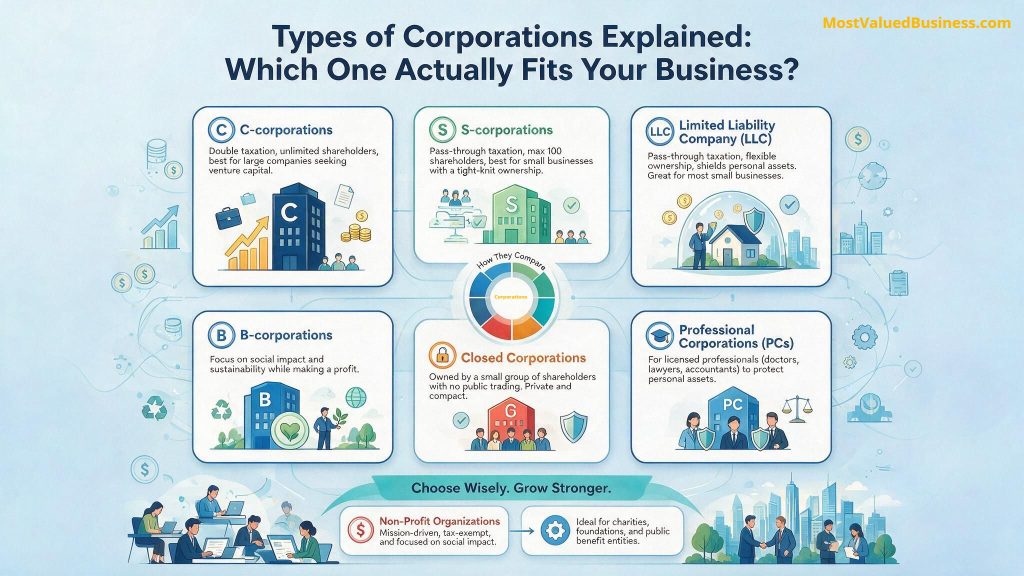
Not every corporation looks the same on paper. In fact, businesses can incorporate as several different types depending on –
- Ownership size
- Tax treatment
- Purpose,
But each is suited to a different kind of founder.
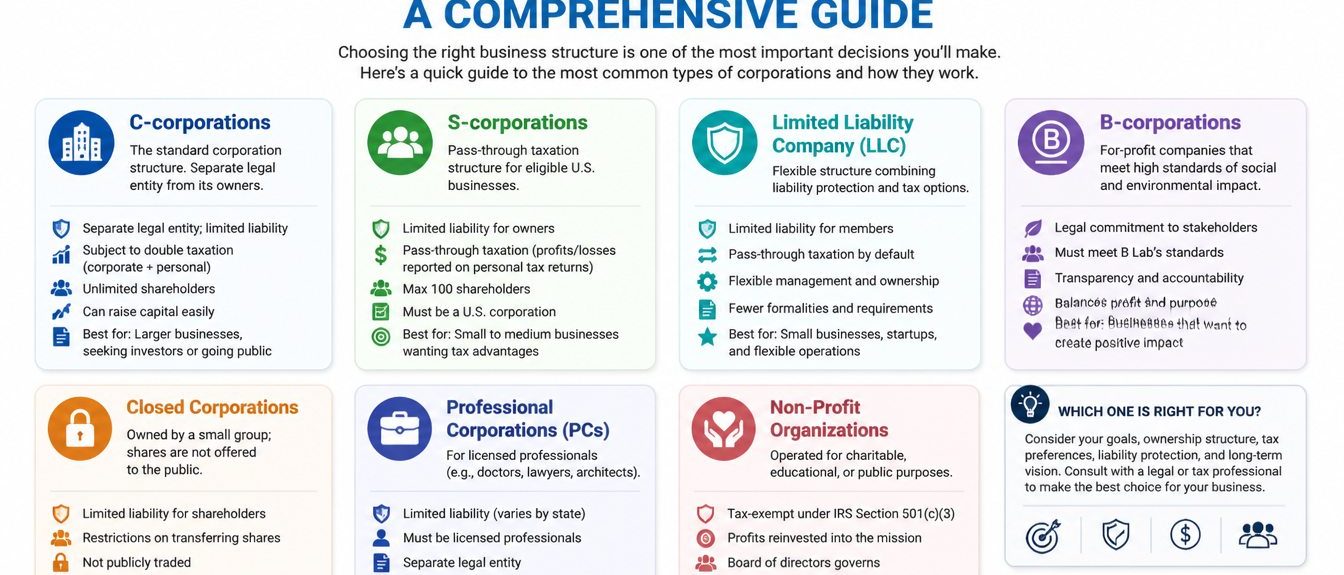
1. C-corporations
Here, the corporation pays the tax separately apart from the taxes of the owners. Thus, there is a double taxation. Most large companies act like C-corporations for federal income tax purposes. They also have the benefit of receiving an unlimited number of shareholders from both domestic and foreign areas.
2. S-corporations
In S-corporations, the shareholders take responsibility for corporate income, credits, losses, and decisions for tax purposes. As they structure themselves as a partnership, they avoid the double taxation that happens in C-corporations. The tax is only at the shareholder level and not at the entity level.
Obviously, not every business qualifies for S-corp status just because it wants the tax break. Basically, the Internal Revenue Service (IRS) –
- Caps S-corporations at 100 shareholders
- Requires that shareholders be U.S. citizens or resident individuals (not other corporations or foreign nationals, with a few narrow exceptions)
- Only allows one class of stock.
So if you’re planning to raise venture capital or bring on international investors somewhere down the road, an S-corp election might box you in before you even get started. So, it’s worth checking these boxes early. It is better than assuming eligibility and finding out otherwise at tax time.
3. Limited Liability Company (LLC)
These companies offer limited liability protection to their owners while protecting them from financial liabilities for any damage to the company’s assets. In LLCs, a Board of Directors is not always necessary, as the owners might decide the business should have the structure of a partnership.
However, an LLC is not technically a type of corporation. It’s a separate legal structure altogether. It is created under its own state statutes. Also, it doesn’t issue stock or have shareholders the way a corporation does.
We’re including it in this list because so many people researching types of corporations end up comparing their options against an LLC anyway. To be honest, that comparison is mostly the whole point of the search.
Just don’t walk away thinking “LLC” is corporate shorthand. If you are after liability protection without the formalities of a board and bylaws, an LLC is worth a serious look. But it lives in its own category rather than under the corporation umbrella.
4. B-corporations
These corporations are based on profits but provide some type of public benefit on behalf of the company’s shareholders. While doing business, they focus on social and environmental performance as well.
5. Closed Corporations
These corporations have a small and select number of shareholders that are associated closely with a business. These corporations do not have a Board of Directors and have less than 35 shareholders.
6. Professional Corporations (PCs)
Let’s say you are a licensed professional – a physician, attorney, accountant, or architect. Many states won’t let you form an ordinary C-corp or S-corp for your practice. Instead, you have to set up a Professional Corporation (PC or PLLC).
The logic behind this is that lawmakers wanted licensed professionals to stay personally accountable for malpractice or negligence claims within their own field. This must happen even while getting liability protection for the business side of things. In general, these include leases, payroll, or vendor contracts.
So, a doctor who forms a PC still can’t hide behind the entity if they’re sued for malpractice. But they are shielded if, for instance, the practice defaults on an office lease.
7. Non-Profit Organizations
Depending on the cause they serve, non-profit corporations reinvest their surplus revenue back into their mission. They do not distribute it to owners or shareholders. This is because there technically aren’t any.
Primarily, forming a nonprofit corporation under state law and getting federal tax-exempt status are two separate steps –
- You incorporate as a nonprofit with your state
- You apply to the IRS for tax-exempt recognition, most commonly under section 501(c)(3). But other categories exist depending on the organization’s purpose.
Skipping the second step means the organization is still incorporated. But it isn’t actually exempt from federal income tax. This trips up a surprising number of new founders.
In fact, most nonprofit corporations rely on a Board of Directors for governance. They depend on donations, grants, or government funding rather than revenue from selling goods or services. However, some do run earned-income programs alongside their charitable activities.
Comparing the Types of Corporations
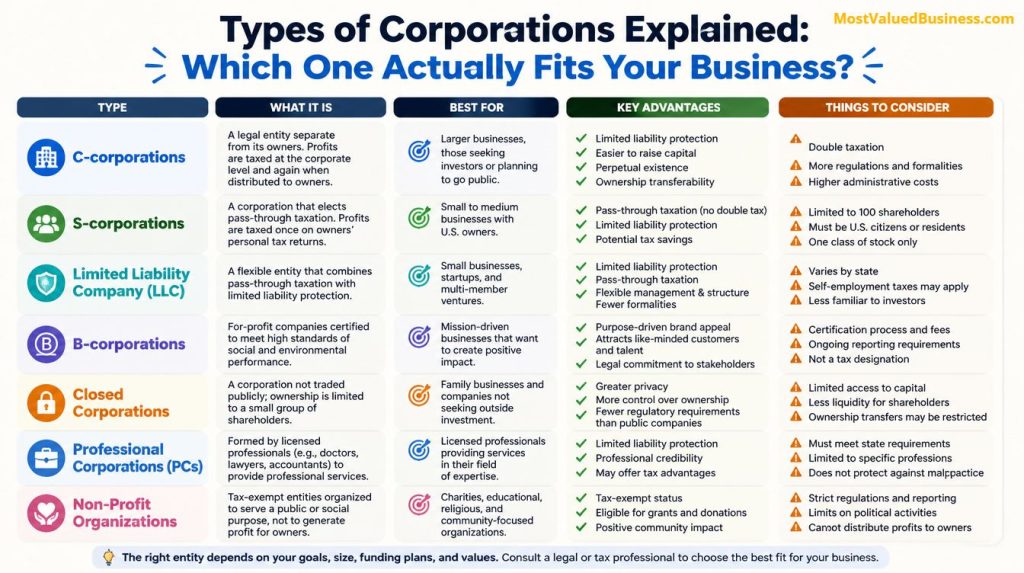
| Corporation Type | Taxation | Liability Protection | Ownership Limits | Best Suited For |
| C-Corporation | Taxed at corporate level, then again on dividends (double taxation) | Strong | Unlimited shareholders, domestic or foreign | Businesses planning to raise venture capital or go public |
| S-Corporation | Pass-through taxation, taxed once at shareholder level | Strong | Max 100 shareholders, U.S. citizens/residents only, one stock class | Small to mid-sized businesses wanting to avoid double taxation |
| LLC (not a corporation) | Pass-through by default, flexible tax election | Strong | No limit, structure set by operating agreement | Founders wanting liability protection without corporate formalities |
| B-Corporation | Same as C-corp or S-corp, depending on election | Strong | Same as underlying tax election | Businesses built around a social or environmental mission |
| Closed Corporation | Same as C-corp or S-corp, depending on election | Strong | Typically under 35 shareholders | Small, tightly held businesses with a few known owners |
| Professional Corporation | Same as C-corp or S-corp, depending on election | Strong for business debts, not for personal malpractice | Limited to licensed professionals in the field | Doctors, lawyers, accountants, architects, and similar practices |
| Non-Profit Corporation | Exempt from federal income tax if 501(c)(3) status is granted separately | Strong | No shareholders; governed by a board | Charitable, religious, or educational missions |
So How Do You Actually Choose?
To be honest, there is no universal right answer here. Anyone who tells you otherwise is oversimplifying. That said, a few questions tend to narrow things down fast.
- Ask whether you plan to raise outside investment or eventually go public. If the answer is yes, a C-corporation is usually the only structure sophisticated investors will accept.
- Ask how many owners you expect to have and whether any of them are foreign nationals or other business entities. That alone can eliminate S-corp eligibility.
- Think about how much administrative overhead you’re willing to take on. In general, corporations require more recordkeeping, board meetings, and formal bylaws than an LLC does.
Ultimately, none of these questions replace a conversation with a business attorney or CPA. They know your specific state’s rules. Also, they are a reasonable starting point before that conversation happens.
A Quick Note On Beneficial Ownership Reporting
Here’s an update for you if you’ve been putting off incorporating because you heard about federal beneficial ownership reporting requirements under the Corporate Transparency Act.
As of August 2026, FinCEN issued a final rule permanently removing the requirement for U.S. companies and U.S. persons to report beneficial ownership information altogether. This narrowed the obligation to foreign entities registered to do business in the United States.
Rules like this have shifted more than once since the law was first enacted. So, anyone forming a corporation should double-check current requirements directly on FinCEN’s website. It is better than relying on older guides. This is because regulatory pages tend to move faster than blog content does.
Where This Leaves You
Corporations carry legal rights and responsibilities that mirror what an individual has. That is true whether one person forms the entity or a whole group does it together. In general, the tradeoffs come down to two things:
- How much liability protection do you need?
- How much tax complexity you’re willing to accept in exchange for it?
If personal liability protection is your top priority and you’re planning to scale aggressively or bring in investors, a C-corporation is usually the safer long-term bet. This works even with the double taxation tradeoff.
If you’re running a smaller operation and want to avoid that double tax hit, an S-corporation might fit you better. It is, provided you meet the eligibility requirements.
If you’d rather skip corporate formalities altogether while still protecting your personal assets, an LLC deserves a serious look. This works even though it isn’t technically part of the corporation family.
However, whichever direction you lean, talk to a licensed attorney or accountant before filing anything. This is because state rules vary more than most guides can fully capture.
Frequently Asked Questions (FAQs)
1. What’s the main difference between the types of corporations?
The main differences come down to –
- Taxation
- Ownership limits
- Formalities.
While C-corps face double taxation, S-corps and LLCs don’t. Meanwhile, professional corporations add licensing-specific liability rules.
2. Is an LLC one of the types of corporations?
No. An LLC is a separate legal structure, not a corporation. This holds even though it offers similar liability protection. Also, it mostly gets compared alongside corporate options.
3. Can a small business qualify as an S-corporation?
A small business might qualify as an S-Corporation only if it meets IRS requirements. These include –
- A 100-shareholder cap
- U.S. citizen or resident ownership
- A single class of stock outstanding.
4. Do nonprofit corporations pay federal taxes?
Not automatically. They must separately apply for and receive federal tax-exempt status after incorporating at the state level. It happens most commonly under IRS section 501(c)(3).
5. Which type of corporation offers the strongest liability protection?
C-corporations, S-corporations, and LLCs all offer strong liability protection. However, professional corporations still hold licensed owners personally accountable for malpractice claims.
| #Disclaimer: This article is for educational purposes & Information only. The right entity depends on your goals, size, funding plans, and values. Consult a legal or tax professional to choose the best fit for your business. |
Need More Business Articles Click On The Below Links:
- What Are The Advantages And Disadvantages Of Corporation?
- What Is Monopolistic Competition? What Are Its Characteristics?
- What Is A C Suite Job Role? What Are Some Examples Of C Suite Job Roles?
- What Is Strategic Thinking? How To Improve Strategic Thinking
- Leader Vs Manager: Must-Know Differences Between A Leader And A Manager
tags
Soumava Goswami
Soumava Goswami is a Content Strategist with 7+ years of experience in creating and strategizing helpful and user-focused content across business, marketing, leadership, and finance. With a strong background in literature and philosophy, Soumava uses memorable characters, narratives, and timeless ideas to make complex corporate concepts easier to understand. Inspired by The Social Network and shaped by his experience with a small MarTech company, he enjoys studying successful businesses. Also, he translates their strategies into practical guidance on leadership, decision-making, customer feedback, operations, and sustainable growth. LinkedIn