Interactive Marketing: Strategies, Examples, Benefits, and Real-World Applications

As new technology comes to the fore, marketing is facing constant change. Marketing is no longer a passive interaction between a brand and its consumers. Meanwhile, the shopping journey is getting fragmented. As a result, brands have multiple active ways to engage with their target audiences.
That is why interactive marketing is necessary. It helps brands to connect with their audiences beyond traditional advertising. Also, interactive marketing enables brands to use new technology dynamically. This helps develop a more engaging connection between brands and their audiences.
Why Interactive Marketing Matters Today
Over the last decade, marketing has changed dramatically. In fact, consumers no longer want to sit back and absorb promotional messages without participating in the experience. Instead, they expect –
- Relevance
- Personalization
- Immediate responses.
Now, digital channels have become too crowded. As a result, attention has become one of the most valuable commodities for brands.
Meanwhile, interactive marketing transforms passive audiences into active participants. It does so through –
- Quizzes
- Polls
- Personalized recommendations
- Live conversations
Those interactive experiences encourage people to engage rather than simply observe. As a result, businesses gain deeper insights into customer behavior. Meanwhile, it simultaneously builds stronger relationships.
Moreover, another important shift involves data collection. There are growing privacy concerns and stricter regulations around third-party cookies. Hence, brands are relying on first-party data.
In those cases, interactive marketing creates natural opportunities. It gathers valuable customer information while delivering meaningful experiences. Consequently, it serves both customer engagement and long-term business growth.
What is Interactive Marketing?
In simple words, this is a marketing strategy where companies make videos and attractive content to engage with consumers. This marketing strategy is to capture the attention of the audience and delight them. Also, making an interactive marketing strategy takes creativity. It also needs to be presented uniquely so that people get attracted to the content.
Primarily, traditional marketing focuses on broadcasting messages. Meanwhile, interactive marketing focuses on developing conversations. In this case, to measure success, marketers do not rely solely on impressions. Rather, they focus on the following aspects:
- Participation
- Engagement quality
- Customer actions.
As a result, the strategy aligns closely with modern customer journeys.
Interactive Marketing vs Traditional Marketing
| Factor | Interactive Marketing | Traditional Marketing |
| Communication Style | Two-way | One-way |
| Audience Participation | High | Low |
| Personalization | Extensive | Limited |
| Feedback Collection | Immediate | Delayed |
| Customer Insights | Continuous | Restricted |
| Campaign Adaptability | Dynamic | Static |
Today’s consumers expect relevance, convenience, and responsiveness. Therefore, businesses that create opportunities for engagement develop stronger customer relationships. Also, they gather more actionable insights than those relying solely on traditional promotional tactics.
Different Types of Interactive Marketing
There are different types of this marketing strategy. These types are as follows.
1. Interactive Videos
If I ask you the best medium to explain something, then your answer will be a video. An audio-visual medium for explaining a topic is a great way, and will also entertain the viewers. Marketers these days have found a new way to engage with the audience by adding CTAs. Companies ask their consumers to subscribe, like, give comments, or share the content.
2. Polls, Surveys, and Quizzes
These are great ways to get more interactions and engagement from the consumers in a funny way. You don’t have to create a poll about your company or products. You can create any buzz about anything. There are websites like interior design, home search, travel, and others that create these to understand the consumer’s thoughts. There are popular tools that you can use for social media marketing.
3. Personalized Content
This is a way to connect with the audience personally. You can address the customers directly through email marketing, and then can make specific ads for them. You can address their needs and then create an impression of your services or products. For example, suppose a consumer leaves an item in their cart. You can remind them about the product by email. This is personal-level marketing.
4. Interactive Calculators and Assessments
Interactive calculators and assessments have become powerful lead-generation tools across industries. They do not merely present generic information. Rather, businesses allow users to receive customized insights. In general, these are based on their specific inputs.
- Financial institutions use mortgage calculators.
- Software companies offer ROI calculators.
- Fitness brands provide health assessments.
This approach works a lot because it delivers immediate value. In fact, visitors receive personalized results within seconds. This makes the interaction feel useful rather than promotional.
At the same time, businesses gain a better understanding of customer needs and purchase intent. Consequently, these tools mostly generate higher-quality leads than traditional contact forms.
5. Interactive Emails
Now, email marketing has evolved beyond static newsletters. In general, modern interactive emails include the following:
- Product carousels
- Polls
- Image galleries
- Surveys
- Countdown timers(that encourage subscribers to take action without leaving their inbox).
The experience feels smoother and more engaging. Rather than asking recipients to click multiple links, brands create opportunities for direct interaction. As a result, engagement rates help improve while customer journeys become more efficient.
6. Augmented Reality (AR) Experiences
Primarily, augmented reality bridges the gap between online browsing and real-world purchasing decisions. In those cases, consumers can do the following:
- Visualize furniture inside their homes
- Try on eyewear virtually
- Test cosmetic products using smartphone cameras.
For many businesses, AR reduces uncertainty during the purchasing process. As a result, customers gain greater confidence in their decisions. This is because they can preview products in realistic contexts. Therefore, brands experience lower return rates and higher customer satisfaction.
Benefits of Interactive Marketing
There are several advantages of interactive marketing.
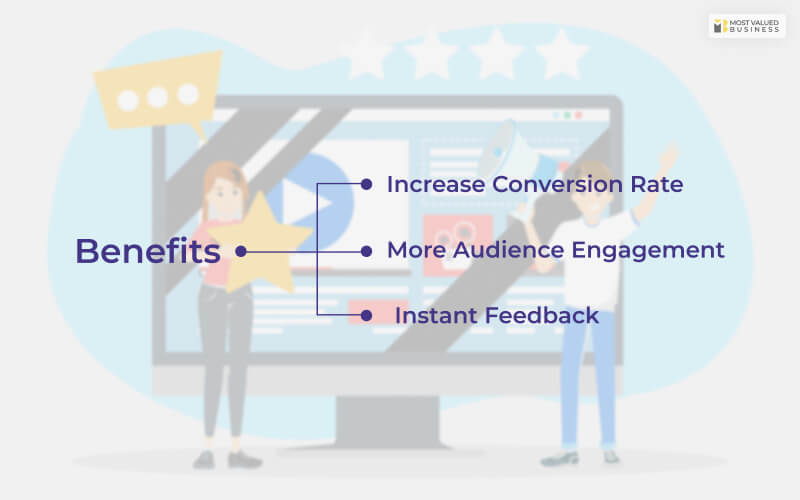
1. Increase Conversion Rate
This marketing strategy is an excellent way to make a potential customer purchase immediately. For example, you can give a different call-to-action to a consumer, which is an effective marketing strategy. There are digital ads that say “Purchase Now.” Or there are attractive products, and then there will be an option that says “add to cart.”
2. More Audience Engagement
To grow any business, audiences are important. Without them, you can not grow your business. And to increase audience engagement, there are different tactics like personalized content, online quizzes, and interactive videos. These strategies give the audience a unique experience, and your business will be fun. If your audiences are happy and feel fun, then they will become your loyal consumers as well.
3. Instant Feedback
One of the best things about interactive marketing is that consumers can give their feedback instantly. You can create polls and quizzes to know their feedback. With these questions, you will learn about your website’s interface, products or services, areas of improvement, and, most importantly, whether your consumers are happy or not. With this marketing, you can connect with your audience and allow them to raise any issue.
4. Better Customer Insights
At the outset, every interaction provides valuable information about –
- Customer preferences
- Behaviors
- Expectations.
Moreover, poll responses, quiz answers, video interactions, and assessment results reveal patterns that traditional advertising fails to capture.
These insights help marketers refine campaigns. Moreover, it also helps them personalize messaging. Also, it helps them identify emerging trends. More importantly, they allow businesses to make decisions faster. These are based on real customer behavior rather than assumptions.
5. Stronger Brand Recall
In general, people remember experiences more effectively than advertisements. Customers develop a deeper connection with the brand behind the experience, when they-
- Actively participate in an activity
- Answer questions
- Interact with content.
As a result, interactive campaigns generate stronger brand recall than static promotional content. This advantage becomes particularly valuable in highly competitive markets. In those cases, differentiation is difficult.
6. Higher Quality Leads
Of course, not all leads carry the same value. Hence, interactive marketing helps businesses identify individuals who demonstrate genuine interest through their actions and engagement patterns.
For example, a visitor who completes an assessment or spends time interacting with a product configurator mostly exhibits stronger purchase intent. It is better than someone who simply views a webpage.
Consequently, sales teams prioritize prospects more effectively. This way, they improve conversion outcomes.
Examples Of Interactive Marketing
As of now, you get to know about interactive marketing and its benefits. But what are some interactive marketing examples?
Here are them.
1. User-Generated Content

The example is so popular these days that so many small and large brands are following it. So what is user-generated content? In simple words, content that is created by consumers and shared by the brand is user-generated content. Through this strategy, brands give consumers the opportunity to get involved, and they will put effort into making content. You can arrange competitions for the best content, or you can share that content on your page.
2. Conversational Marketing

For small companies or regional businesses, conversational marketing is a great way for both marketing and sales. For example, suppose you have a website. But people don’t visit that so often. What you can do is make attractive social media profiles and share your products. You don’t have to put your website link, but people will definitely ask or show their curiosity about the product if they find those interesting, worthy, and attractive. After that, it is your duty to convert them into customers.
3. Personal Thank You

One of the best ways to engage with consumers and make them feel valuable is to thank them personally. For example, let’s take the example of a consumer who has been buying products for many years. After every purchase, you can thank them with an email and a small gift voucher or a coupon. As a result, first of all, they will always be loyal, secondly, the shopping count will rise, and thirdly, they will spread the word. And lastly, your brand reputation will increase.
4. Playable Video Game Ad
This is one of the popular ones these days. I am giving you an example that I have recently faced. I was playing a game on my smartphone, and I couldn’t complete the level within a specific number of moves. So, for additional moves, I had to watch 3 videos. And you know what? The first video consists of a playable game, and I played it for 30 seconds, then downloaded it. This is an excellent interactive marketing example.
Frequently Asked Questions (FAQs):
Here are some effective and common examples of interactive content.
1. Interactive Infographics
2. Quizzes
3. Polls and Surveys
4. Assessments
5. Interactive Emails
6. Webinars
There is a huge difference between internal and interactive marketing. Internal marketing means the engagement between a company and its employees. On the other hand, interactive marketing means the engagement between consumers and the employees of a company.
Interactive marketing is important for these reasons.
1. Consumers find interest
2. More engagement means more followers, and more followers mean more conversions.
3. Help consumers in the purchasing journey.
4. Get to know the feedback easily.
5. Making a loyal consumer base.
Interactive marketing involves two-way communication. Meanwhile, traditional marketing primarily delivers one-way promotional messages.
Yes. Interactive experiences guide users through decision-making. Also, they encourage actions such as sign-ups, purchases, and inquiries.
Interactive Marketing Is a Core Growth Strategy
Interactive marketing changes how businesses build relationships with consumers. Now, brands do not rely solely on promotional messages. Rather, they focus on creating meaningful interactions. Those interactions encourage participation and dialogue.
Moreover, consumer expectations are continuing to evolve. Hence, engagement has become a major competitive advantage. Meanwhile, interactive experiences help businesses gather valuable insights. Also, it helps strengthen customer relationships and improve conversion opportunities throughout the customer journey.
Final Words
I hope that you have found this article interesting and helpful. As you get to know about interactive marketing, it is time to imply that in your business. Also, remember to be polite, be a good listener and always be ready to come up with a solution to be a good marketer. If you have any further information, let us know in the comment section below.
Thank You.
Read More:
- What Is Telemarketing? Explained With Examples
- What Is Brand Marketing? Explained With Examples
- What Is Marketing And What Are The Types Of Marketing?
- How Is an Advertisement Different from a Comment from a Regular Consumer?
- How Customer Success Teams Drive Business Growth Through Client Satisfaction?
tags
Soumava Goswami
Soumava Goswami is a Content Strategist with 7+ years of experience in creating and strategizing helpful and user-focused content across business, marketing, leadership, and finance. With a strong background in literature and philosophy, Soumava uses memorable characters, narratives, and timeless ideas to make complex corporate concepts easier to understand. Inspired by The Social Network and shaped by his experience with a small MarTech company, he enjoys studying successful businesses. Also, he translates their strategies into practical guidance on leadership, decision-making, customer feedback, operations, and sustainable growth. LinkedIn