The New Rules of SEO in 2026: Why Creative Strategy, Local Search, and Technical Precision Are Non-Negotiable for Canadian Businesses

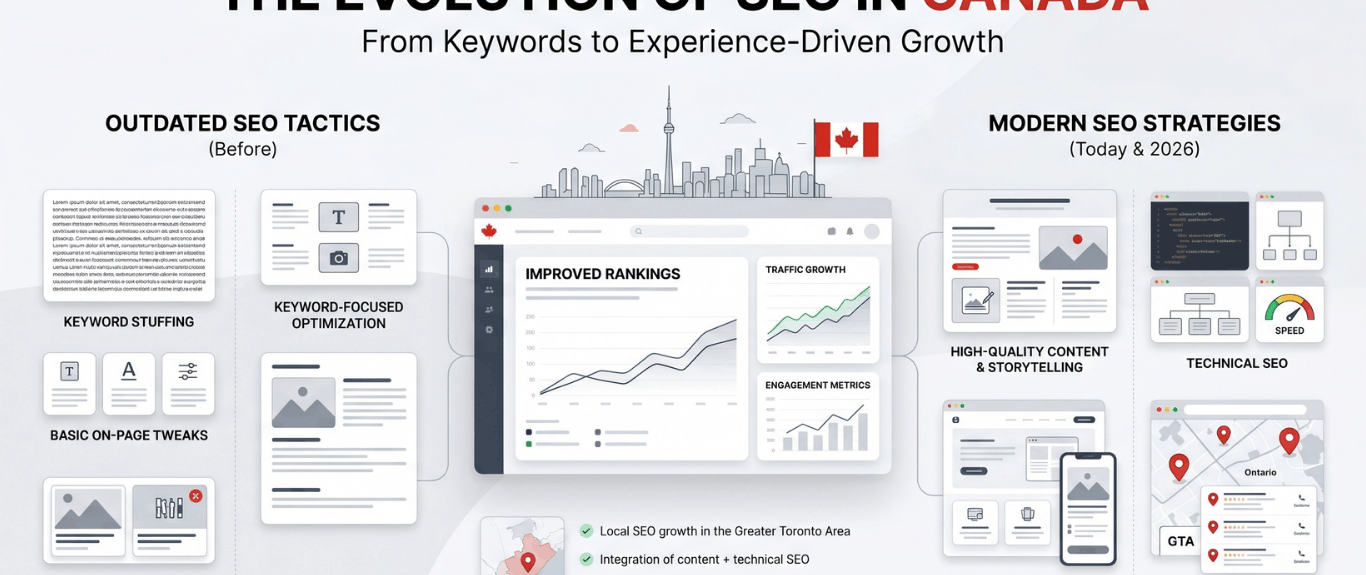
Search engine optimization in 2026? It’s not what it used to be and not even close. Back in the day, you could stuff a few keywords, tweak some meta tags, and boom, rankings, traffic, leads. Now? That playbook is dead! Search has grown up, and if your strategy hasn’t, you’re already behind.
But SEO has changed its course with time from guesswork engineering to psychological chessplay. If you are working on SEO, you have to consider the perception and intent of the people. Moreover, you have to understand that search engines interpret intent and how your website actually performs under the hood. You miss one piece, and things start slipping. Especially in Canada, markets like Ontario, the GTA, they’re crowded.
Many of them are partnering with the expert SEO agency Markham to navigate these new complexities and build campaigns that deliver results. Businesses that adapt over time, they open the possibility of growth. Basically, SEO has become more important than ever to stay in business. Let’s break it down.
Why Creative Strategy Has Become Central to Modern SEO
Here’s the thing, Google isn’t just reading your content anymore. It’s understanding it, and more importantly, it’s judging it. Not harshly, but intellectual. Does your content help? Does it answer the question the user wants to know? Does it feel real, or just written for rankings?
That’s where creative strategy kicks in. You can’t just write anything in your content. You have to mean something, solve something, and speak like a human. Because that’s what your audience expects, and honestly, deserves.
Think about it. When you search for something, you don’t want fluff. You want clarity. Maybe even a bit of personality. Something that feels like, “Yeah, this gets me.” So, content in 2026 needs depth. It needs intent. And yeah, it needs structure too, but not robotic structure.
For example:
- Instead of “best plumber Toronto,” you build content around real problems.
- “Why your pipes freeze in winter and what to do about it.”
- See the shift?
Now you’re not chasing keywords. You’re aligning with intent. Also, Google’s Helpful Content system? It’s filtering out surface-level stuff. So if your content doesn’t add value, it just won’t stick. Bottom line, you’re not writing for Google anymore; you are actually writing for users in Google who are waiting to be explored with accurate information.
The Rise of Local Search: Getting Found in Your Own Backyard
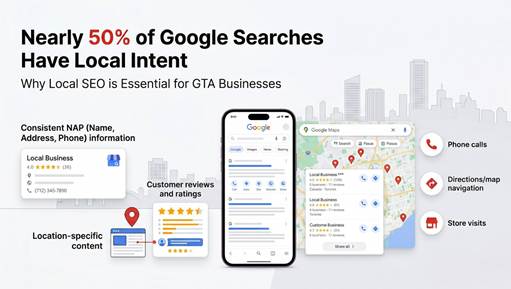
Local SEO is having a moment. Actually, more than a moment, it’s dominating, and almost half of all searches now have local intent. That means people aren’t just browsing, they’re looking to act, call, visit, and buy. And if your business doesn’t show up locally? You’re invisible.
Let’s say you run a service in Markham or Vaughan. Someone searches “best HVAC near me.” Google shows a map pack under the tab “Places” with three listings. Maybe a few are marked as sponsored. If you’re not there, you’re not even in the conversation.
So what matters?
- Consistent NAP (Name, Address, Phone)
- Google Business Profile optimization
- Real customer reviews (not fake, not forced)
- Location-based content
But here’s where it gets interesting, local SEO isn’t just technical, it’s trust-driven. However, people trust businesses that feel close, familiar, reviewed, and actually still active. And mobile search? That’s driving this even more. People search while walking, driving, or deciding.
So yeah, local SEO gives faster wins compared to national strategies. It creates a sphere where there is less competition, higher conversion, and real leads. If you’re a Canadian business, especially in the GTA, ignoring local SEO is like opening a store with no signage.
Technical SEO Fundamentals That Still Matter in 2026
Let’s not overcomplicate this. You can have amazing content, but if your site is slow, broken, or confusing, it won’t rank. Technical SEO is still the backbone. And honestly, it’s where many businesses quietly fail. So what matters now?
- Site speed (people won’t wait, neither will Google)
- Mobile responsiveness (most traffic comes from mobile)
- Clean URL structures
- Proper indexing
- Schema markup
Take URLs, for example. Something like “yourwebsite.com/services/toronto-seo” is clear, simple, and very readable for both Google crawlers and the audience. Now compare that to “yourwebsite.com/page?id=38274.” It’s very messy, meaningless, and doesn’t make browsing very appealing. Since users prefer clarity, Google emphasizes that. Also, Core Web Vitals still matter. Not just as metrics, but as experience signals. If your site jumps around while loading or takes forever, users bounce. And that sends signals. So yeah, technical SEO isn’t glamorous. But it’s necessary. Think of it like plumbing. You don’t see it, but if it breaks, everything else does too.
Scalable SEO Strategies for Growing Canadian Businesses
Here’s where things shift, from doing SEO to building systems. Because once your business grows, manual efforts won’t cut it, you need structure. Let’s say you expand into multiple cities. You can’t just duplicate pages and hope for the best. You need a scalable content framework. That includes:
- Content clusters
- Internal linking strategies
- Template-based landing pages (but not spammy)
- Consistent keyword mapping
Also, workflows matter. Who creates content? Who updates it? Who tracks performance? Without systems, things get messy fast. And then there’s tools. Not just for tracking, but for maintaining SEO health. Starting from rank tracking to perform technical audits. The goal? Make SEO repeatable. So when you launch a new service or location, you already know what to do. That’s how strong brands scale.
The Legitimacy Factor: How SEO Signals Trust in 2026
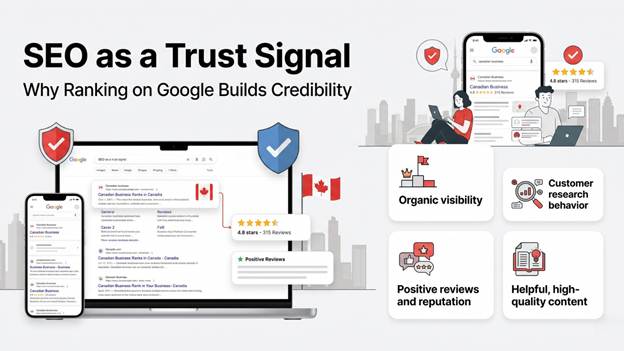
Let’s be real for a second. When you search for something and see a business ranking at the top, you trust it more. You might not even realize it, but it happens. That’s the legitimacy factor. In 2026, SEO isn’t just about visibility; it’s about credibility. People research everything now. Reviews. Content. Presence.
If your business shows up consistently, with helpful content and strong signals… it builds trust before the first interaction. And trust? That drives conversions. Also, Google’s getting better at evaluating authority. Things like:
- Backlinks from trusted sources
- Brand mentions
- Content depth
All contribute. So if your SEO strategy is only focused on traffic, you’re missing the bigger picture. You’re building a reputation.
Common SEO Mistakes Canadian Businesses Still Make
Even now, businesses repeat the same mistakes. Over and over, let’s call them out.
1. Over-optimization
This happens when you force keywords unnaturally into content just to rank. It usually shows up in repetitive phrases or awkward sentences. For example, “best SEO agency Toronto” is stuffed everywhere. It hurts readability, and yes, search engines pick that up fast.
2. Ignoring mobile experience
This kicks in when your site isn’t built for phones. Slow loading, broken layouts, hard-to-click buttons. You’ve seen it. For example, a page that looks fine on desktop but is messy on mobile. Users bounce quickly, and rankings drop with it.
3. Weak content
This is thin, surface-level content that doesn’t actually help. Happens when you write just to fill pages. For example, a blog that repeats basics without real insight. No depth, no answers. Users leave, and search engines don’t reward it.
4. No local consistency
This happens when your business details vary across platforms. Different addresses, phone numbers, or names. For example, one listing says “Suite 2,” another doesn’t. Confusing, right? Search engines lose trust—and your local rankings suffer.
5. Treating SEO as a one-time task
This happens when you optimize once and stop. No updates, no tracking, no improvements. For example, publishing content and never revisiting it. SEO needs ongoing work. Skip that, and your rankings slowly fade out.
Also, many businesses chase trends instead of building fundamentals. They jump into AI tools or automation, and hacks. But if you skip the basics, that is where things break.
Building a Future-Proof SEO Strategy for Your Canadian Business
So what does a solid strategy look like in 2026? Not complicated, but layered. You need:
- Strong content (useful, human, relevant)
- Clean technical setup
- Local optimization (if applicable)
- Scalable systems
- Ongoing analysis
And most importantly, you need consistency. SEO isn’t about spikes; it’s about steady organic growth through online presence. Also, be ready to adapt since algorithms change and user behavior shifts. The businesses that win? They stay flexible! They don’t feat to take test, taking immediate steps, and learning from them. And they don’t panic every time Google updates something.
The Role of AI and Automation in SEO Today
Let’s talk about the elephant in the room, AI. Yes, it’s everywhere. Content generation, keyword research, and audits. And it’s useful. No doubt, but here’s the catch: AI can’t replace strategy. It can assist. Speed things up. Give ideas.
But it can’t understand your audience as you do. It can’t build real connections. So if you rely only on AI-generated content, it shows. Flat tone. Generic insights. No depth. Use AI as a tool. Not a replacement. That’s the balance.
Measuring SEO Success: What Actually Matters Now
Rankings? Still important, but not everything. In 2026, you need to look deeper in few factors that are shaping modern SEO.
- Organic traffic quality
- Conversion rates
- Engagement (time on page, bounce rate)
- Local actions (calls, direction requests)
Because what’s the point of traffic if it doesn’t convert? Also, attribution matters more now. Users don’t convert instantly. They visit multiple times, through different channels. SEO plays a role across that journey, so measure it properly.
Wrapping It Up: SEO as a Long-Term Investment
Here’s the truth. SEO isn’t quick and not at all easy if you are starting from scratch. At the same time, its nor very static and rigid. But what amazing thing is that it works. If you commit to it, clarify your daily, weekly, and monthly goals, and it is going to work for you.
In 2026, SEO is about balance, where you combine all. You have to balance creativity with technicality, or local with scalable, even human and data-driven results. And if you focus on genuinely helping your audience, while keeping your technical side clean, you’ll see results.
Maybe not overnight, but steadily and consistently. And that’s what actually matters, because at the end of the day, behind every search, there’s a person. However, if you can serve them better than anyone else, you win.
FAQ – Frequently Asked Questions
Short answer? It takes time. Usually, you start noticing small shifts in about 3 to 6 months. Rankings move a bit. Traffic picks up slowly. Then, bigger results show up around 6 to 12 months. But here’s the thing, local SEO and technical fixes can hit faster. Meanwhile, competitive keywords? They take patience. You’re in it for the long game.
Yes. Still huge. Maybe even bigger now. Think about how people search, “near me,” “in Toronto,” “Markham services.” That’s local intent right there. And if your business shows up in those results, you’re already ahead. Strong local SEO brings in real leads. Calls. Visits. Not just random traffic. So yeah, if you’re in the GTA, you can’t ignore it.
Honestly? It’s everything now. Search engines don’t just scan, they evaluate. If your content actually helps, answers questions, and feels real, you win. If it’s shallow or generic, it gets ignored. So, you need depth. Clarity. Value. Add solid technical SEO on top, and that’s where real growth starts kicking in.
Depends on what you’re trying to do. If you serve a specific area, local SEO should be your focus. That’s where quick wins happen. More visibility, better conversions. But if you’re targeting a wider audience, national or online, then broader SEO makes sense. Most businesses? They mix both. Local for immediate impact, national for long-term reach. That balance usually works best.
Read Also:
tags
Freddy Wosten
Freddy Wosten is a dynamic author. As a Blogging enthusiast and professional for the past 10+ years. And he is loving every bit of it. He lives in New York City. His niches are Business, Lifestyle, Tech, Real Estate, Finance, Travel, Social Media, Entertainment, and Multi-subjects. He is currently on Content Operations Senior Executive | to TechRab.com & MostValuedBusiness.com.